No Free Water in Flight —

“Desert Airline: My Fight for Water at 30,000 Feet”

I recently boarded a Scoot flight, a subsidiary of Singapore Airlines, expecting at least the bare minimum of what air travel has promised passengers for decades: free water. What I experienced instead was shocking — a flight where water was treated as a luxury product rather than a basic human necessity.

Midway through the flight, I looked around the cabin. Not a single passenger was ordering water. It wasn’t because nobody was thirsty — it was because we were being charged for something that should never carry a price tag. Hundreds of people sat quietly dehydrating, strapped into their seats, with no other choice.

When I spoke to a flight attendant, I asked them to simply look around. “If you offered water to passengers, I’m sure no one would refuse,” I said. The crew were polite but unmoved; the policy was clear: water was only available for purchase.

This isn’t just a matter of comfort. At altitude, the human body faces dry air, low humidity, and changes in pressure — all of which accelerate dehydration. The human body is about 60% water; depriving people of this essential element during hours of confinement is not just poor service, it’s dangerous.

What makes this worse is that even animals transported for slaughter receive regulated access to water, yet paying passengers are being denied this most basic right. I raised the issue with Australia’s Civil Aviation Safety Authority (CASA), but was told it wasn’t considered a “safety issue.” This answer is deeply disappointing and highlights a gap in aviation oversight.

Water has been free since the inception of commercial flights. It is a symbol of care, hospitality, and common sense. Turning it into a paid product — especially in an environment where passengers cannot meet their own needs — is inhumane and exploitative.

I’ve since written a formal complaint to Scoot, Singapore Airlines, and aviation regulators, demanding this policy be overturned. This is not about one airline or one flight; it’s about basic dignity and health standards in air travel. No passenger should have to pay to avoid dehydration in the sky.

In my email to the airline I concluded with a thought: ”Imagine: if you were personally given the monumental task of deciding whether passengers should be given water—fully aware of the risks of dehydration and knowing that water has always been free since the inception of commercial flights—would you deny it? Your honest answer to that question would reveal much about yourself and your values”.
1 Like

Providing free water isn’t a right. This website provides further details:

https://www.escape.com.au/travel-advice/are-airlines-required-to-serve-free-water-on-flights/news-story/a28fe88d7bdab4eeaa18abdb90b417c5

Scoot or a lot of other budget airlines can chose to sell water rather than flight crew providing a glass of water. They are low cost airlines for a reason.

Many other modes of transport for long journeys also don’t provide free water on route. Example being trains and buses.

Scoot also makes it clear that only bottled water is available on its flight. This bottle water must be purchased.

A very easy solution, which we do, is take your own water bottle. We do this when ever we fly. Not only does it reduce waste, but, having one’s own bottle means one can consume it at will, rather than pushing a button or walking to the galley to be served. It is far more convenient.

3 Likes

Thanks for your reply, but I think you’ve actually made my point for me.

First, bringing your own water isn’t a realistic solution because, as you surely know, airport security takes water off passengers before boarding. You can’t refill it mid-flight because there’s no safe water source onboard that’s free to use — unless you pay for it. So suggesting “just bring your own” ignores the reality of international travel regulations.

Second, you mention trains and buses, but planes are not trains or buses. At altitude, in a pressurized cabin with very dry air, the human body dehydrates much faster. That’s why dehydration is a real health risk in aviation, and why airlines historically provided free water as a basic welfare measure.

Finally, your response shows exactly what I feared: if people were given the responsibility to decide whether to provide passengers with water, some would simply say “no” without considering health impacts. That attitude proves why this issue matters — because when basic necessities are turned into “paid extras,” passengers’ well-being is treated as an afterthought.

Flying shouldn’t feel like crossing a desert where water is a luxury. It’s about basic care and dignity, not luxury service.

1 Like

We have found there is the opportunity to fill one’s own bottle between security checks and the plane door.

Some custom clearances require the bottle to be emptied. This is to ensure contraband (flammable liquids, alcohol etc) isn’t taken onto the plane. If they require the bottle to be emptied, it can be filled with the airport gate area. Airports generally have a number of options, including:

  • wall mounted or free standing drink water dispensers. These are more common in countries where tap water can’t be consumed.
  • special bottle filling stations
  • in rest rooms, especially where tap water is safe to drink
  • food outlets. We use these as a last resort as often some require a purchase to fill a bottle. Some refuse. Some oblige.
  • lounges, if one has access to airport lounges
  • taps in toilet basins - one we also avoid

We have travelled in Asia, Americas, Europe, Australia and NZ, and have never had problems filling our water bottles in gate area of the scores of airports we have passed through.

A passenger needs to also understand the services an airline provides, and make necessary preparations for travel. This includes whether water is available inflight and whether there is a cost associated with it.

As outlined above, Scoot makes it clear they have bottled water on flights, only available through purchase.

Not necessarily. I have been on trains in the tropics which were not air conditioned, and have lost significant quantities of sweat through the skin (clothing was wet through where excess could be wrung out). Far more than the equivalent length flight. Likewise buses.

But Scoot does provide and have water available to passengers. They just require payment for it. Scoot also has the option to prepay for water during the booking process (see Others towards the bottom of the page) - for those that don’t wish to bring their own. Likewise meals as these are also an optional extra.

If Scoot didn’t have water on board for passengers, refused to sell water or couldn’t sell water (say card machines weren’t working), then this would be a problem and grounds for complaint. None of these appear to have occurred on your flight, as it was indicated some passengers chose not to buy water for some reason.

People need to eat as well as drink. Scoot doesn’t prevent passengers from eating or drinking, they just have to pay for it.

It is no different to some trains with dining cars. If one doesn’t take their own, they can buy it in the dining car.

Some restaurants in Australia also don’t offer ‘free’ water. If one wishes to have a glass, usually the options are still or carbonated. They can refuse to give a glass of tap water. Many of these restaurants aren’t at the budget end, where one might expect to pay for everything.

As a final comment, one has a choice on what airlines to fly with. If one thinks every airline should be full service, maybe a budget airline shouldn’t be considered and a full service airline is used instead.

6 Likes

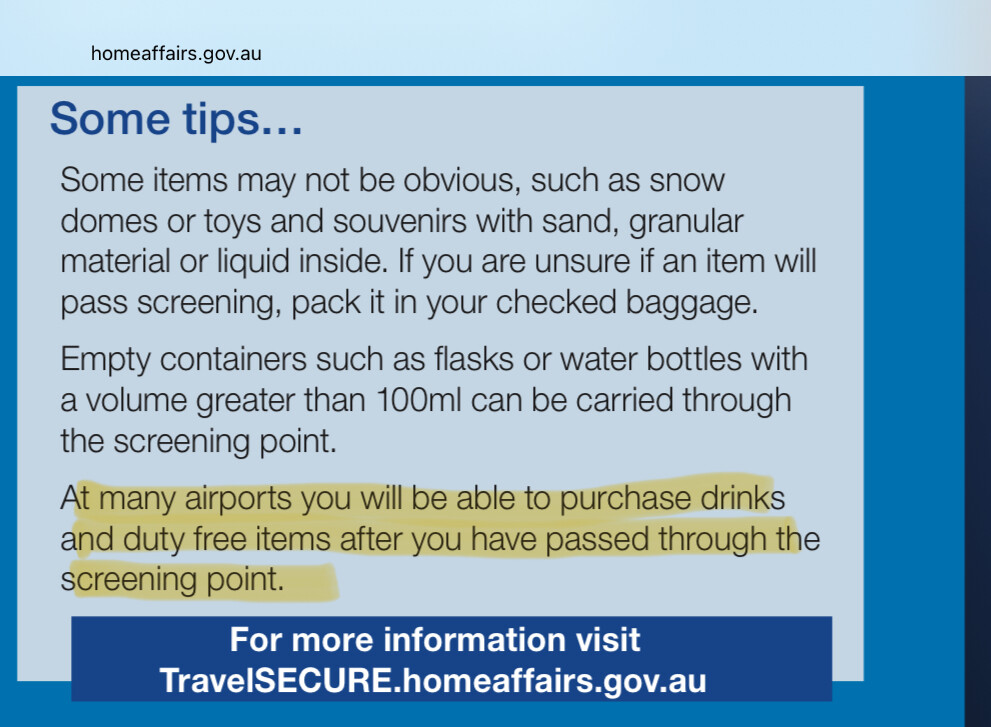
Water bottles only need to be emptied before passing through security. Then there are many water fountains or shops to buy bottles of water to take on board. This has been my experience at Melbourne’s airport.

Scoot is a budget airline based in Singapore. They describe themselves as ‘wallet-friendly flights’ and travellers should make sure they understand all the options including buying food and drinks on board.

4 Likes

Been having a look at flights from Melbourne to Singapore, one passenger, return.

Prices range from cheapest, Scoot, to the more expensive Emirates (operated by Qantas Airways). The difference between the two amounts to thousands of dollars.
The medium price difference between airlines is about 1k.
‘Scoot’ is the cheapest and offers no-frills flights, there’s some extra payment for food and drink and in-flight entertainment, but considering that many hundreds of dollars have been saved on the price of the ticket, surely to pay a few dollars for a bottle of water by those

would not be unreasonable :slightly_smiling_face: keeping also in mind that we can take our own bottle of water on board once past the security area.

4 Likes

Scoot is not the only option. Booking ahead?

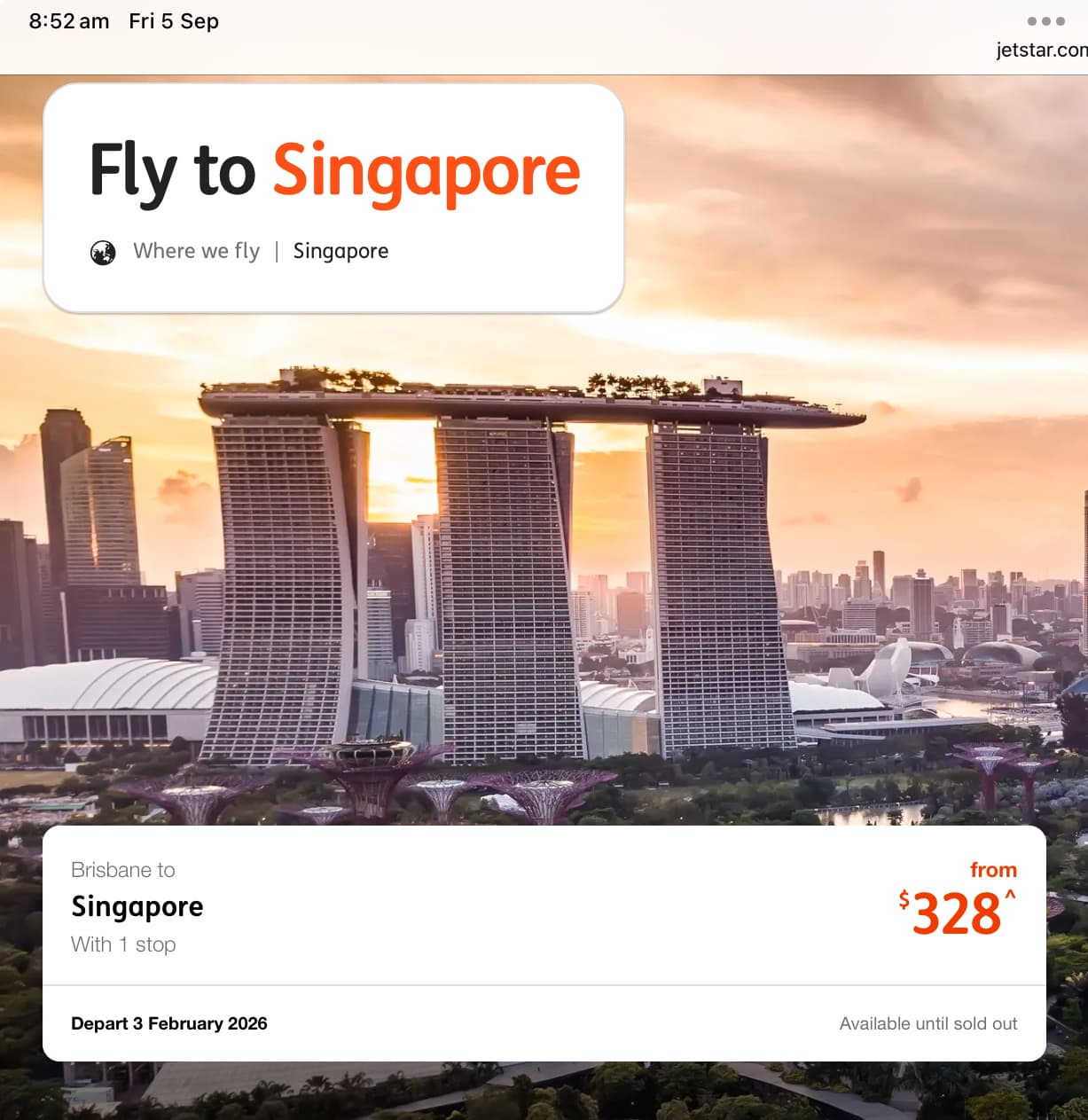
Like Scoot Jetstar lowest cost fares may need to be topped up to include baggage etc. And for sustenance - (approx 250ml of water per hour a common recommendation - although personal needs will vary).

The passenger air supply on board a modern passenger plane relies on filtration, conditioning and a pressure management system built into the plane. One could say that system being part of the plane along with the wings and engine is included in the cost of the ticket. No need to pay extra. :wink:

5 Likes

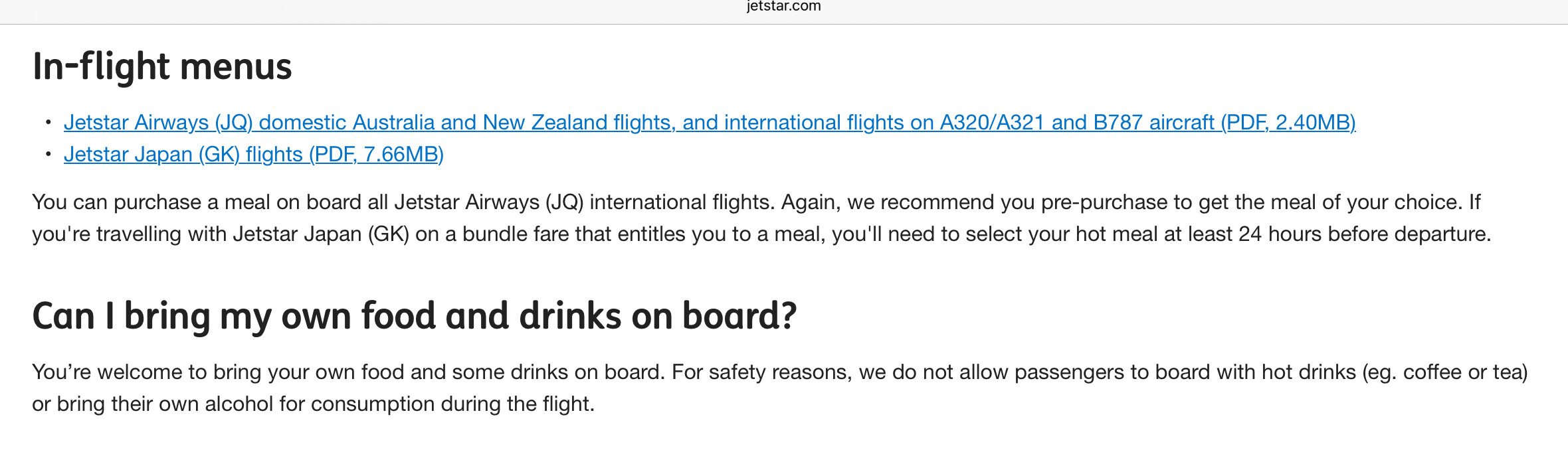
Thanks for the screenshot from Jetstar confirming our practice of taking our on water onboard is legal and can be done. The ‘some’ relates to alcoholic beverages which can’t be taken onboard

In relation to Jetstar, we have taken water on Jetstar flights as well, with the knowledge of Jetstar flight crew. They knew as it was cooled boiled water to make up formula for our child. One of the Jetstar crew took the water to the galley to warm it for us when asked, which was greatly appreciated.

We have taken our own bottled water on:

Jetstar (Domestic)
Qantas (D & International)
Virgin (D)
China Southern (I)
China Eastern (D)
DragonAir (D)
Emirates (I)
Fly Dubai (I)
Singapore Airlines (I)
Latam (I)
Turkish Airlines (I)
Japanese Airlines (I)
AirAsia X (I)
Royal Brunei (I)
Vietnam Airlines (D)
EVA Air (D)
Air New Zealand (I)
Sky Airlines (D)
JetSmart (D)

All these airlines, there could be more, we have taken our water onboard. I know this because we always take our own water and snacks. We also now travel with mints to help ear de-pressurisation during decent, as some airlines no longer give out hard sweets for such use.

We, like many families who do likewise, have never had any issues with taking one’s own drinking water bottles on the plane.

Something I didn’t mention is we take and reuse single use drink bottles for the purpose. This is in case we go somewhere where customs/security screening policies are different to the norm, and find the water bottles are confiscated. We are yet to have this happen with the scores of flights and domestic/international airports we have been through.

We also take metal water bottles (Sigg or similar) in checked-in luggage to use day to day while travelling. Can recommend Sigg bottles as they are lightweight aluminium bottles which don’t leak when bouncing around in a daypack.

5 Likes

My first experience with Jetstar was years ago (2016). I was late registering for a tour and found myself on my own on a Jetstar flight to Bangkok.
The booking asked for extra payment for food, choosing from a menu of their choice.
The no-frills has been going on for a while. As a rule, the cheapest fares come up on top even if there’s some compromises to consider.

PS there’s no need to be strapped into our seat on a plane unless the plane is: ‘moving on the ground, taking off or landing, or in case of any turbulence’

3 Likes

Thanks for starting this important discussion @Opiniologist, and for the comments so far suggesting strategies to avoid issues. It is very important when flying with a budget carrier, especially on a long haul flight, to be prepared as it’s usually not all inclusive.

There are a couple of aspects to this that I wanted to discuss from a consumer perspective. There was a recent report in The Australian (paywalled) regarding a Batik airlines flight from Bali. The article states,

In Denpasar, however, all water bottles are confiscated at the gate for security reasons. The only way to get a drink on board is to pay for it, and the tap-payment device is kaput

This is in reference to the secondary security screening that can occur at the boarding gate, literally right before you walk on the plane. Bali is not the only airport that does this, it occurs in Dubai and other airports and it means it is not possible to bring any water on the plane, free purchased or otherwise.

We need to acknowledge that is seen as a neccessary security measure, and that is not our area of expertise. However, in our interest we do have reports of vending machines located post security, at terminal gates. Consumers purchasing from these machines, assumingly to stock up before a flight where only more expensive items are available, will have these items immediately confiscated. The application of this second screening at the gate is not necessarily well known, applied consistently or even disclosed. So even the most well organised, savvy consumers among us may end up in a frustrating situation where we’re getting ripped off by a predatory practice.

It’s a problem that can and should be easily solved, one way or another. However, I know, because I speak to many of them, that it just adds to an already long list of people’s frustrations around the lack of rights when it comes to travel. We’ve been campaigning on this for some time, and sadly there are still many situations where through no fault of our own, we get the short end of the stick.

We know that from a health perspective, it is important to stay hydrated on long flights. The responsibility of airlines to conduct their operations with a duty of care is legislated in a number of ways, but as pointed out, they don’t have to serve you water. Because airlines have traditionally included drinks and meals inclusively, this hasn’t really come into the public view often. In 2019, a woman sued Emirates after breaking her ankle when passing out from what she claimed was a lack of water. She lost the case, which you can read about here, because meals and drinks were made available during the flight.

Would this case be different if it were brought against a budget carrier? We can only speculate, but in a medical situation there are also rules and stipulations for airlines. If airlines were regularly breaching their duty of care and causing actual harm to their customers by failure to provide water in a captive environment, it should become a matter of interest. In at least one case as mentioned above, we have an airline refusing to provide water when their own payment systems are down. It is ludicrous but apparently neccessary to point out that we shouldn’t have to risk serious medical issues for the common practice of air travel.

It goes without mentioning that in terms of business practice, it would appear that airlines leave a bitter taste in the mouths of many when they refuse water or emply other practices that leave people feeling ripped off.

Not everyone is travelling for leisure, or with excess resources, and there may be other barriers that should have a bearing on this discussion. But where possible, the most important thing is to look after your health when you travel, and good planning including some emergency funds that you can ‘write off’ can help ease the many types of frustration that can occur on travel adventures.

Here’s a poll if you’d like to share your opinion, and please continue the discussion, it will continue to be of interest for us at CHOICE. Just a final note, we appreciate people will have different perspective on this topic, which can be divisive. Take the time to appreciate each other’s point of view, and as always treat each other with respect and kindness. We’re all consumers after all.

  • Should airlines offer free water?
  • Yes
  • No
0 voters
4 Likes

With all due respect, this topic has drifted a bit. My point is simple: water is the most basic need after air.

Everywhere in the world — homes, restaurants, offices — the default question is, “Would you like a glass of water?” It’s universal hospitality. Nowhere is it more necessary than on an aeroplane at 30,000 feet.

If liquids are confiscated at the gate, airports and airlines have a duty of care to ensure free access to safe drinking water on request, especially when payment systems fail. This isn’t about planning better; it’s about basic safety.

Humans can go about 30 days without food, roughly 3 days without water, and only minutes without air. Water is basic, abundant, and precious — and increasingly contested. Treat it as essential, not optional.

— OP

TL;DR: Once the system removes your water, the system must provide water. Duty of care, not upsell.

Free? No that isn’t something they have to do. Having access to water is necessary, payment though can be imposed. Not everywhere even in Australia is there always free access to potable water.

From Water: the invisible problem. Access to fresh water is considered to be a universal and free human right, but dwindling resources and a burgeoning population are increasing its economic value - PMC

Since 1992, when water was declared to be an economic good in the International Conference on Water and the Environment (ICWE) Dublin Principles (ICWE, 1992), the call for higher water prices and for more trade in water has gained consensus (Saleth, 1997). This perception has been reflected in influential magazines; The Economist , for example, reported that “the best way to deal with water is to price it more sensibly” (Anon, 2003).

People depending on where they live may have to pay for water, even Councils charge home occupants for the water supply (including the amount they use). When you buy a ticket to travel by plane (or even bus or train) there are conditions attached to that travel, this may include that the traveller has to pay for food and/or drink (including water).

3 Likes

Agree - water has become a saleable commodity. Some restaurants offer still or sparkling and charge for both as they have been filtered optionally carbonated. There are branded products which market their systems including bottles specifically to those businesses. The upsell the potential return on what comes out of the tap for a fraction of a cent. For the restaurant etc there are other costs, including purchase, consumables, and the staff time to prepare and service the customer. Although some of these overheads existing even when free tap water was on offer. The treated water now enables one to explain the added cost. At some little different to that charged for service and a bottle of imported premium Italian spring/mineral water.

Should one have the option of bringing for self consumption into a restaurant? While a meal is usually not an 8hour flight, when one is attending a function or event water and glasses are typically on the table at no added cost. It’s a mixed bag.

International aviation has its own rules as does each nation for their air terminals. Likely well beyond the reach of any one nations consumer organisations.

4 Likes

Not to be argumentative @opiniologist, but offering water in public and business spaces gratis is cultural and varies. There are many countries where restaurants do not provide free water, tap or otherwise. We even have a popular tavern in the Yarra Valley that is on undrinkable bore water - want water with your meal? It comes in a bottle and costs. Same with items like bread with meals and sauces (ketchup/sauce/mustard). Most visitors from North America expect bread free w/meals but accept the cost since ours is usually a few steps above; but they are often appalled at the ask of $0.50 to $1.50 for a little tub of sauce with their F&C.

I agree being in an airplane is a special case, especially on long haul flights. Airlines continually find new ways/things to charge for such as reserved seats, location of a seat, carry-ons, etc not just water for those that partake. But as with most things there are multiple views.

6 Likes

Agree with those who have said that water is not actually Free, there’s a cost involved in sourcing it and in obtaining it. Those airlines that include a bottle of water with meals have costed it in the price of the ticket. We do pay for it after all.

4 Likes

I support what others have said in relation to the claim that it is universal and free.

More recently we have been working in the hospitality industry and many providers (accommodation, restaurants, attractions, transportation) no longer provide complimentary water as part of the service. We have even seen signs warning of not drinking water from taps. One has no choice but to use bottled water (either purchased or take their own). This might be sign of the times or as indicated above, part of their Duty of Care.

It would fall into duty of care as a supplier of water needs to confirm the quality of water being supplied. There are potential liability issues if someone is injured in some way by drinking water provided by someone else. This can be the case when the drinking water is contaminated by some means through its handling (say someone not washing their hands exposing others to communicable diseases, poor cleaning practices and poor or damaged delivery systems). These exist in Australia and around the world. It is worth noting that Scoot is an Asian carrier which services many locations where reticulated water quality is very different to that in Australia. In many countries it services, tap water is unsafe to drink, and some bottle water quality may not meet that of other countries such as Australia.

Bottled water, which I personally think is a environmental evil in many causes when it is used for no apparent reason, improves safety and can assist in protecting the consumer’s health. This is the case when risks exist of providing non-bottled water or water not contained within a sealed container.

All bottled water comes at a cost. Some business decide to pass this cost directly onto the consumer to allow them to reduce their cost of services (e.g. Scoot)…while others include such costs within the price a consumer pays for the services (e.g. full service airlines like Singapore Airlines which is Scoot’s owner). Either way, the consumer pays directly or indirectly for the water.

Having travelled on budget/low service airlines (last experience as AirAsiaX from OOL to KUL) and many full service airlines, we now only use full service airlines for longer legs as they generally are an all inclusive price (drinks, meals, entertainment etc). We do use budget airlines from time to time, but, confine our travels to shorter domestic hops of no more than a few hours.

I haven’t struck an airline which doesn’t have water available, either complimentary or as a paid extra when on board. In the 30 odd years of flying as a passenger, I have only been on one flight where inflight service was cancelled and all aboard had to stay seated with belts on. It was on a Ansett flight from GLT to BNE. Thinking back one couldn’t get anything, including water, during the flight as the route was through a fairly rough change in weather. Getting something was the least of my worries.

In relation to secondary screening at a gate, we have only struck this once when returning to Australia (we have also struck it when departing for Russia and China). We were told at the time as it was in the decade post 9/11, it was a requirement of the Australian government and not the airline or airport (we suspect but can’t confirm that the primary airport screening may not have met Australian standards and thus a second screening occurred prior to boarding). We may not have experienced what some other did, but, we were shepherded into a separate room after secondary screening waiting for all passengers to arrive at the gate to be screened. We then all waited for the plane to be ready for boarding. It was a box room with rows of seats, with a cold water fountain and M/F toilets. We had to wait about 15 minutes before boarding was allowed - not a enjoyable experience. Our China and Russia experience was similar, the difference being flight crew went around checking passports to ensure that one had a valid visa in their passport. This process was longer as everyone’s passport had to be reviewed. Again, there were basic facilities attached to the room. I had to go to the toilet, and was sternly accosted to by a Russian steward when I stood up as the flight crew were worried that I was moving around trying to avoid their checks.

At the end of the day, Scoot did not deny any passenger water. The issue appears to be that they required passengers to buy water onboard as they had advised, as they aren’t a full service airline. I appreciate the information you have provided, as it reinforces our own views on using cheaper budget airlines for longer flights. Scoot is another airline we will now avoid for such routes.

6 Likes

Yes. Those in favour of free water bottles on budget airlines are also, possibly unknowingly, supporting an increase in the cost of a budget air fare. The low prices depend on the minimum costs associated with the flight. Instead of costing-in free bottles of water for everyone, the cost is on the individual user. The company can only afford to be ‘low-cost’ by cutting many of what they call Frills; actually it means paying separately for baggage, no in-flight entertainment, etc..

A waiter offering a glass of water when seating patrons is not being generous, the cost of supplying and serving a glass of water is included in the price of the meal.

2 Likes

Just in relation to universal and free, and right to access clean drinking water, the UN outlines human rights in relation to water and sanitation:

https://www.unwater.org/water-facts/human-rights-water-and-sanitation

While it recognises access to drinking water is a human right (universal access):

Access to water and sanitation are recognized by the United Nations as human rights – fundamental to everyone’s health, dignity and prosperity.

The UN also recognises there is a cost associated with providing safe drinking water and states access needs to be affordable:

The right to water entitles everyone to have access to sufficient, safe, acceptable, physically accessible, and affordable water for personal and domestic use.

Often it is thought is is a basic right and must be free, this isn’t the case.

If the UN had a policy that drinking water must be provided free, it could be the end of the commercial drinking water industry and lawyers would be taking governments to the UN as they would breach this policy.

3 Likes

UPDATE from OP: Why this is about SAFETY, not convenience

I’d like to add some clear facts to this discussion because this is not just about planning ahead—it’s a genuine health and safety issue at 30,000 feet.

An average man has about 5.5 litres of blood, and an average woman about 4.5 litres. On a 10-hour flight, studies show men can lose around 2 litres of water and women about 1.6 litres, mainly from the plasma (liquid) portion of the blood.

Here’s what that means in real terms:

  • Blood becomes thicker (higher viscosity), which strains the heart and increases blood clot risk (DVT).

  • Blood volume drops, which can lower blood pressure and trigger dizziness or fainting.

  • Cognitive performance falls—even 1–2% dehydration slows reaction time, focus, and decision-making.

  • Electrolyte imbalance raises the chance of muscle cramps, irregular heartbeat, or seizures (dangerous for people with epilepsy or other conditions).

  • Dry mucous membranes in the nose and throat lower immunity, making passengers more vulnerable to infections.

At altitude, in a pressurised cabin with 10–20% humidity, dehydration accelerates rapidly. Once passengers’ water is confiscated at security, airlines and airports must take responsibility. This is not an upsell opportunity—it’s a basic duty of care.

We all accept security protocols, but water is as essential as air. Humans can survive 30 days without food, 3 days without water, and only minutes without air. Denying easy access to something so basic in a sealed environment is a health risk, not a travel inconvenience.

Given the well-documented health risks of dehydration, I wouldn’t want to be sitting next to someone who might have a medical emergency or a seizure in mid-flight. That’s a serious aviation safety concern. You wouldn’t want to sit next to one. would you?.

I agree that dehydration poses significant health risks. As outlined above, the issue isn’t about dehydration but one choosing not to buy water when it was available.

I believe there are enough responses from a range of different posters which indicate that water isn’t free and which address this issue.

3 Likes