Someone is bound to reject the possibility that an update could brick a car, as it does with phones, computer based appliances (eg TVs etc) or just computer parts from time to time. There are ways to make a fail safe fall-back, but do they? I do not know.
It can happen and has been known to do so. A problem with automatic OTA updates - of phones, PCs, cars, etc - is that there might not be any notification given about it. So the device, whether it’s on wheels or not, is suddenly dead or malfunctioning and you don’t immediately know why.
So I think you should at least be given the opion of being prompted about all updates, and be able to defer them.
1 Like
I own a Tesla and follow their activities. I find most people, including many auto journalists as well as business analysts have a poor to limited understanding of the company. Tesla are a technology and software company that makes cars and trucks, as well as energy, AI and robotics products. Nothing they do is static for long and is constantly being innovated and refined. They are nothing like other automakers in that they are extensively vertically integrated and control their products, manufacturing, software and AI development and even raw materials inputs and materials development (eg cast underbody sections)
See their https://www.tesla.com/impact reports for details.
They do have a way to go with many aspects of their vehicles, such as self driving and auto wipers however my 2021 model 3 is a noticeably better vehicle now than when i got it 3 yrs ago. Some people won’t like this, however most i know embrace and love it. Their ongoing free OTA updates are notified via the vehicle and the excellent app, with release notes. Many so called recalls are self reported and fixed via OTA far faster than legacy automakers can even work out they have a problem. There are occasional regressions of functions however my experience has been these are quickly corrected.
3 Likes
Depending on one’s outlook, a fun read (spoiler - the problem seems to have been an EOL battery timed with an update) but waking to a ‘pining’ car is probably not fun.
An EOL 12V battery, that is.
I know someone who bought a 2013 Nissan Leaf from Good Car Co a few months before I did, and not long after he got it, it suddenly wouldn’t start. Turned out that the 12V battery had died.
He hadn’t known until then that EVs even have a 12V battery.
His experience meant that I knew about this before I got my EV; and because Good Car had been getting a few reports of seemingly healthy 12V batteries that came with the cars imported from Japan suddenly dying, mine was given a brand-new 12V battery. 
3 Likes
Reuter has done some investigations into known vehicle faults in Tesla vehicles being blamed on driver misuse/abuse:
If one has had faults with their Tesla vehicle and Tesla wiping their hands of the fault, by blaming the vehicle driver/owner for the problem, it might be worth seeking legal advice or advice from your local office of fair trading.
The practices of Tesla outlined in the article is extremely shonky.
The Reuters article has been largely debunked as another hit piece against Tesla.
This from a commentator on Tesla Blasts Reuters Report That Sparked Senator Involvement As “Manufactured Story” | Carscoops
“It calls out the publication for not focusing on the fact that the lead first-person account of a broken suspension part not covered under warranty happened because that person allegedly hit something with their Tesla. “The customer was informed that Tesla was able to review the telemetry and understood there was a crash that resulted in this repair not being covered by warranty,” it wrote.”
This part of the story was the most incredulous. It was a poster on twitter demanding free service for his car with 20 followers and about 12 total tweets. He was mentioned, by name, by almost every automotive magazine, without a hint of skepticism. His story didn’t make sense. 14k in damages from a broken ball joint or control arm? Nah. In no world does that make sense.
Would be nice if Reuters shared whatever documents they claim they have that shows Tesla is aware of problems and not addressing them. That would be problematic, but alas they haven’t been transparent and I don’t trust their automotive expertise ATM.
See also from Tesla
https://www.tesla.com/blog/addressing-misleading-claims
Tesla definitely have work to do with their customer relations however ive yet to see concrete evidence they act fraudulently, unlike the bunch of Japanese automakers, including Toyota who have admitted falsifying crash test and emissions data which barely gets a peep out of most media, but misleading articles mentioning Tesla get picked up without question by every outlet and put on banner headlines.
1 Like
Im not sure what point are you trying to make? It’s also not fun for the tens of thousands of ICE vehicle drivers who find their vehicles immobile when they need them.
This is from 2021 however it unlikely to change much yoy.
Moreover, to highlight further the benefits of software enabled vehicles such as Teslas, they started sending notifications re low voltage battery degradation.
1 Like
Stories are not always what they appear to be from the headlines, if that.
Not quite, Tesla responding against allegations doesn’t debunk the Reuters article.
The Norwegian government investigated the claims about faulty rear control arms in response to numerous complaints lodged with them, to determine if a recall should be issued. While they found there were quality issues with the control arms,:
“The Norwegian Public Roads Administration (NPRA) believes that a break in the rear lower control arm does not constitute an unacceptable risk, and that there is no basis for demanding a recall of the vehicles,” according to a statement from the regulator in the report.
the decision to not recall was based on the fact that most cases happened when the car was traveling at low speeds, and often reversing
The issue isn’t the presence of a faulty control arm, but Tesla blaming owners when they fail. While there may be one off examples that a driver can be accused of causing a faulty part to fail, there have been numerous complaints, enough so to make the Norwegian government to investigate. Even if a faulty control arm failed through something in part a driver did, under Australian Consumer Law, if a part is faulty it is covered by the Australian Consumer Guarantee and the responsibility of Tesla to resolve. As indicated in my earlier post,
The Reuters banner headline is correct. Why…the Norwegian Government started examining the failure of the cross arm after receiving numerous complaints in 2022. This examination occurred well before Reuters released its own investigation. Any reasonable person would know that it would not be possible for a public examination in relation to product safety by European governments (Sweden and Norway) without the knowledge of the business in question. A reasonable person would also know that with product safety recalls, the business subject of investigations of whether a recall should occur provide input into the investigation. Telsa indicating that they don’t know about the potential faults is implausible.
They can argue that it isn’t a warranty issue, but, this seems to be contrary to what the Norwegian government has found that failures occurred, but the risk didn’t warrant a government instigated product recall. The Swedish product safety examination is yet to be published and would be worth reading when it does.
I agree, particularly when it comes to electric vehicles and especially Tesla.
The Australian Govt has a register of recall notices.
https://www.vehiclerecalls.gov.au/recalls/browse-all-recalls?f[0]=make %3A112&f%5B1%5D=product_category%3A7
To note the system of recalls covers serious defects affecting safe use and operation. No vehicle brand/manufacturer large or small is without a spot on the list. Tesla has 20 entries since 2015. Well down the list and off the screen shot.
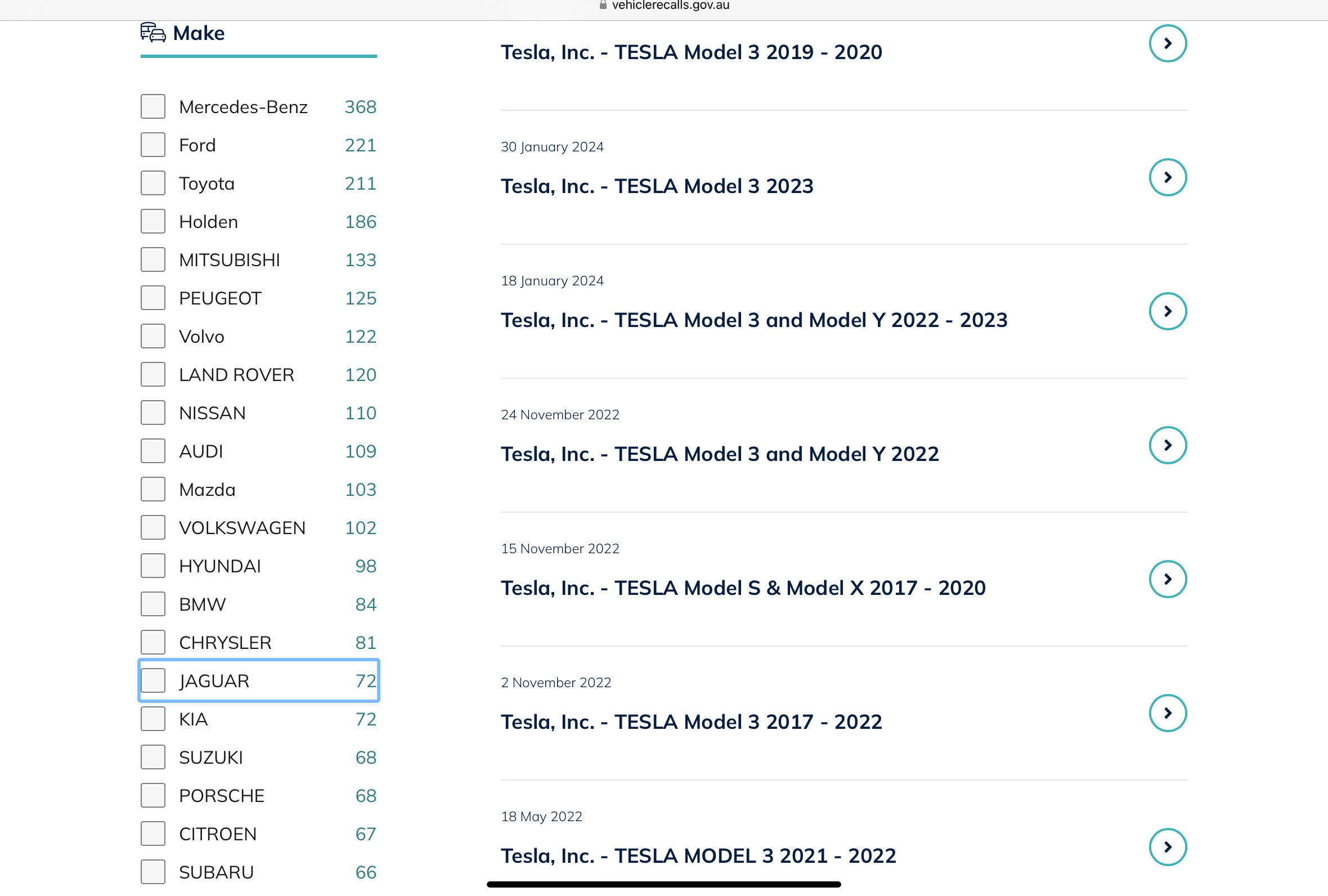
In context there are other brands with low sales volumes and total numbers of road registered vehicles with comparable numbers of recall notices relative to market share. Some such as Porsche have a longer sales history. Others such as RAM (the full size “pick up” aka faux truck product) have been in the Aussie market for a similar time period. Lesser market share but in the same price range as the most expensive Tesla products. Nine recalls since 2015 for the RAM brand with the most recent an electrical defect with the potential to cause an engine bay fire. Mercedes list includes 280+ recalls since Jan 2015, (approx 0.5M registered passenger vehicles as of Jan 2023). https://www.bitre.gov.au/sites/default/files/documents/BITRE-Road-Vehicles-Australia-January-2023.pdf
Edit - footnote:
There have been calls at different times for a more comprehensive reporting of all vehicle faults/defects and recalls. IE not limited to only safety recalls. AN aid to better understanding make reliability and how well brands respond to consumer needs.
EG Does Australia have a vehicle defect register?
6 Likes
Goldman Sachs state that the EV battery prices will fall a further 50% and will bring parity with ICE vehicles by 2026.
4 Likes
This is not specifically EV news, but it will affect new Hyundai vehicles of all types.
Bring it on, I say.
With the advent of touchscreens in vehicles, accompanied by the departure of any kind of button or dial that one could manipulate without having to stare at the screen, I’ve often wondered why it is that using these screens while driving isn’t acknowledged to be as dangerous as mobile phone use while driving is.
Both practices can take the driver’s attention away from the road for periods long enough to cause serious accidents, because of having to look at the screen to know where to touch – even if just turning music / heat / cooling / fan down, up, or off.
In an earlier age, you could do that without looking.
It should now be possible to control touchscreen functions by voice command, though. Should that be mandated while driving, like hands-free phone calls?
3 Likes
Consider language/accent issues. As this stage of development it would be problematic to say ‘turn on the air conditioning’ in American (midwest, southern, or New England, …), UK (Welsh, Liverpool, Scottish, Northern Irish, London, …), and especially when English is an additional language, all requiring a library of complex analyses. How does it discern both ‘what the driver asked’ and who is the driver entitled to make the change, or was it spoken by a passenger. There are ways to do that by identifying where the voice came from, but just highlighting that is not necessarily practical (yet) until voice recognition is taken to another level. Phone calls are optional, controlling the vehicle not so much.
2 Likes
Yes, that is true of all voice-operable systems. They have to be trained to recognise a particular voice … and sufficiently well-designed so they reliably only react when actually asked to do something, via a ‘safe’ activation word or phrase that isn’t going to come up in normal conversation! I spent some time a while back with a relative who has an iPhone and an Apple smart watch … and one or other of those kept butting into the conversation when it thought it’d been summoned.
I was just pointing out that voice commands are the only way to use button-less touchscreens reasonably safely while driving. Not intending to suggest that this is a reliable solution at present.
3 Likes
EVs would make great house batteries and grid stabilisers. That’s taken a step closer to reality.
One reason it’s not here already is that regulations and processes haven’t been in place. On Saturday, climate change minister Chris Bowen announced progress on this front. Vehicle to grid would be up and running by Christmas. That’s a very ambitious timeline, as there’s more to it than just regulations. But it is a jump forward.
…
So what just changed? Crucial underpinning – the boring but important scaffolding which makes new technology robust and reliable. Specifically, Standards Australia has approved a new standard for bidirectional chargers.
4 Likes
But don’t hold your breath! It’s likely to be six months or more before bidirectional chargers are available (possibly at a less than eye-watering price), and even then, very few EVs currently in the Australian market will be able to take advantage of them.
1 Like
One way forward - a dedicated V2G charger. Hopefully we have not created a local (only the Aussie way) solution.
Meanwhile - the rest of the world seems to be well ahead of Australia with the latest releases and announcements (aka bleeding edge products).
Sungrow a popular inverter and storage solution brand in Australia has moved on to include V2G as part of a home Solar PV solution.
P.S.
Sungrow also has a foot in the door with standalone EV chargers. It’s coming to the market with more than a little experience. Sungrow has also been successful delivering new technology products at very competitive prices.
1 Like
Something to look forward to!
But the other catch (ie, other than that it’ll probably be six months before any chargers are approved and on the market), as described in the ABC article I posted (with my emphasis):
What vehicles support V2G?
The other big catch: V2G is not supported by most EVs.
Currently, only three cars on sale in Australia support V2G:
- Nissan Leaf
- Mitsubishi Outlander plug-in hybrid vehicle (PHEV)
- Mitsubishi Eclipse Cross (PHEV)
But these cars use a CHAdeMO plug standard that’s being phased out in favour of another, more widely used standard, CCS2. The new V2G chargers awaiting CEC approval will only be compatible with CCS2.
Dr Sturmberg says the Leaf, Outlander and Eclipse Cross won’t be compatible with the next generation of V2G chargers.
The CHAdeMO-plug-compatible Wallbox Qasar 1 V2G charger used by Jai and other Nissan Leaf owners has been discontinued by the manufacturer.
“What we do with the 30,000 older Nissans is a bit awkward given many were initially sold because of V2G,” Dr Sturmberg says.
1 Like
