A number of revelations, including the often high levels of sugar. A discussion that fits into more than one topic, profits rule?
Convenience of the prepared products sold in the supermarkets is supported by marketing promoting the healthy qualities etc of the products. One could now ask if most are lies if healthy eating is the most important outcome? Surprisingly it’s reported sugars are often added to savoury foods to improve acceptance. Would any parent add sugar to a home prepared puree or mash of chicken and vegetables? No need to wonder why some children having had store purchased product, reject home made, (or as ours sometimes chose to toss the whole plate on the floor).
As much a call out to hold super markets to account as they can be part of the solution, and the industry brand giants for a Shonky.
A correction, the WHO doesn’t have standards. The document in question is the WHO’s Nutrient and Promotion Profile Model, which can be found here for those who are interested:
The NPPM sets out nutrient and promotional requirements across different product categories. It may be adopted in full or locally adapted to evaluate product suitability, inform product reformulation and guide policy reform to support public health goals for optimal infant nutrition and development.
Choice has in the past raised concerns in relation to the quality of baby foods. Articles prepared by Choice can be found here:
To note Choice has not reviewed/tested baby foods since ….prior to 2016? It does offer a range of advice on baby and toddler food choices. Also on snack foods for babies and toddlers.
Calling out the WHO for not having standards?
No need to correct. We are all free to choose whether one only accepts a legally supported standard recognised by Australian legislation, as setting a standard. Or choose a higher bar, and not the one set for the winner of a limbo competition.
More seriously, what ever the current requirements are for prepared baby and toddler foods sold in Australia, better health outcomes appear to be absent. To mention as well the supposedly “discretionary” but in reality daily snack foods.
The WHO NPPN has no status in Australia. At best, it is for information purposes only.
Australia is deficient in policy settings for specific infant/toddler foods, with exception possibly of infant formula.
This is barking up the wrong tree. If there isn’t any requirements in Australia, supermarkets and manufacturers can’t be held to account. As a result, current situation isn’t shonky.
If finger pointing is to occur, it should be towards successive Commonwealth governments and Food Standards Australia. It is well known that there are issues with foods marketed to infants and toddlers, including those identified by Choice in the past, but this hasn’t resulted in action by those who can ensure these issues are addressed.
This brings to mind a NY Times article (behind a paywall, so I can’t quote it) I saw in February this year about high lead levels in ‘applesauce’ fed to American babies. It was in single-serve foil sachets imported from Ecuador, flavoured with cinnamon imported from south Asia that had been processed by a spice milling company in Ecuador. The likely source of the lead contamination was the spice mill, and probably because lead chromate (!) was added to the cinnamon to bulk it out.
What emerged from that incident is that the US doesn’t exert enough control over the safety of imported foodstuffs, even those aimed at babies.
We can’t assume Australia does, either, when it’s not exerting control over what’s marketed to/for babies and toddlers.
Parents feeding babies almost exclusively on highly-processed commercial ‘baby food’ is not done (only) for convenience, but because they really want to do the right thing by their children. After years of being hammered by advertising, many actually believe the hype that commercial baby food is perfectly balanced nutritionally and is better for the bub than home-prepared meals could be.
Since the first half of last century, companies like Nestle have heavily promoted the idea that baby formula is somehow better for babies than human milk. That caught on so well (helped by the convenience factor, of course) that it wasn’t long before very few North American babies were being breastfed at all.
Formula and baby food have been great little earners for Nestle and the others. More recently they’ve been pushing “toddler food” and “toddler milk” – which is pretty much a scam, as those are entirely unnecessary. Nutrition specialists say that toddlers (if they don’t have allergies or other special nutritional needs) should be given ordinary full-cream dairy milk and pretty much the same foods as the rest of the family’s having (suitably adapted to avoid choking etc).
This just happens to be far cheaper than buying special formula and processed foods, too.
Exploiting parents’ desire to do the best for their children has been great for the shonky industry giants’ bottom lines.
What a pity they haven’t at least tried to live up to their own hype and make sure the stuff they’re selling is genuinely safe and well-balanced nutritionally. Is it so hard to remove extra sugar and salt – and not add lead?!
My first reaction to this was great scepticism as there is no apparent motive.
Lead chromate is bright yellow and heavy, it bears no resemblance to cinnamon in looks, taste or smell.
If you were selling powdered cinnamon by the gram bulking up with something that resembles it like sawdust that would be cheaper and easier. In a prepared product what would be the point?
However at least part of the story is true. The US CDC and FDA both weighed in.
FDA’s leading hypothesis remains that this was likely an act of economically motivated adulteration.
Lead contamination can occur from the soil or the air during plant growth, but in some instances, cinnamon and other spice suppliers may intentionally add lead chromate to enhance the color or increase the weight of the product.
Cinnamon, which comes from the bark of a tree, can absorb “lower levels of lead” found in the soil where it’s grown through its roots or contact with the bark, Laura Shumow, the executive director of the American Spice Trade Association, said in an email. The trees take approximately 10 years to grow and that “provides a long timeline over which lead may be taken into the tree,” she said.
Jenna Forsyth, a research scientist at Stanford’s School of Medicine who has studied the intentional adulteration of spices, said even a “small sprinkle” of lead chromate “can result in several percent increase in weight.”
In the case of the cinnamon applesauce pouches, federal investigators have said the lead contamination was “likely an act of economically motivated adulteration.” Investigators detected up to 5,110 parts per million of lead in samples of cinnamon collected from the manufacturing facility in Ecuador. By comparison, the European Union limits lead in cinnamon to 2 parts per million.
The lead levels in the supermarket ground cinnamon mentioned in the article were much lower, 2 to 3 ppm, and considered likely to have been “environmental” rather than deliberate contamination.
This implies the adulteration was further up the supply chain than the makers of the applesauce.
The moral of the story is if you buy powdered or milled spices you cannot be sure what you are getting, as in the great oregano fraud When oregano is not oregano
Information online indicates that the contamination was from a processing operation in Ecuador or from the supplier in Sri Lanka (Food Safety News). Information also suggests that it was a one off which was picked up by food industry/regulator testing regimes. It is worth noting that the cinnamon in question wasn’t bound for the US, but to SE Asia. It could have been added to SE Asia bound cinnamon as many countries in this region do not have the same regulatory environment as many developed countries.
Unfortunately when there are cases such as the Ecuadorian example found, it is often thought that it is wide spread and something that every consumer should be concerned about. In this particular example, it doesn’t appear to be widespread and no more than a single source in Ecuador.
There have been other examples where the contamination has been more widespread, such as:
and resulted in precautionary actions in Australia:
So should there be?
Supermarket and brand marketing frequently leans on how much they care about their customers and the outcomes of the products they choose to sell. It’s a judgement on the ethics of the businesses.
Agree it’s a choice of a supermarket chain to sell what they choose. Also to fall into line with the manufacturers marketing priorities. Often excused with they only sell what customers demand.
Are the products all that they promise?
A lack of enforceable requirements from FSANZ or Govt is in this instance a poor excuse for not doing what is best for the health of those the products are intended for, vs what is best for the shareholder. Should companies or their shareholders be free of moral responsibilities. That’s aside from the difference between the overt marketing claims made on behalf of many of the baby and toddler food products, the nutritional values and relative value compared to home made. Shonky to promise something a product does not deliver, IMHO.
Reality is not all need to agree for change to happen. However nothing changes if we don’t speak up. Choice offers one of the few opportunities for consumers to call out businesses whose actions and products cause more harm than good. All the more challenging when key vested interests are multi nationals with deep pockets to press their interests.
If that is the case, the finger should be pointed at parents who choose to buy off the shelf, highly processed infant foods.
Parents are given a lot of information about what is right nutritionally for their children (this is the information we were provided in Qld). We have raised our own following such advice (and our own knowledge), and never purchased off the shelf, highly processed infant foods.
These foods, like fast foods, are there for a convenience. Convenience has a cost. Like any processed foods, the price paid is lower nutritional value.
I agree it is a discussion that should happen. Whether a change is needed could be determined by such discussions.
Something which also needs to be discussed is why parents choose to buy highly processed foods for their children, how many rely on such foods and the long term consequences.
The ABC which looks at the possible overhaul of the health star rating system. The article also touches on the labelling of foods, including infant foods:
I have noticed ads lately for powdered drinks ‘for the elderly’. Catching customers at both ends of life!
My children were very rarely given baby food, and if for some reason they were, rarely ate it, probably because it tastes pretty awful tbh. When they were babies they had home made baby food and then moved on to whatever the adults had. It’s just marketing making people believe that every stage of life needs ‘special’ food. I think if you studied nations with the healthiest populations you’d find they eat the same foods from cradle to grave but the key would be very little processed food.
As for convenience it really doesn’t take much effort to whip up a batch of pureed pumpkin or whatever and freeze it…
There are several threads on that topic here. I would prefer that rather than scrapping it there needs to be several big improvements.
Making it compulsory would be the best and easiest. The scheme had a post implementation review and once again the government duffed it and let the industry have their way and leave it as optional. The result is many of the least healthy products are not rated.
I don’t blame companies for not embracing the health star rating system when you have unsalted butter getting a one star rating, contents cream and water, whereas frozen chips get a 4 star rating and contain 12 plus different ingredients. Granted most of the ingredients are ‘natural’ but frozen chips are still a highly processed food.
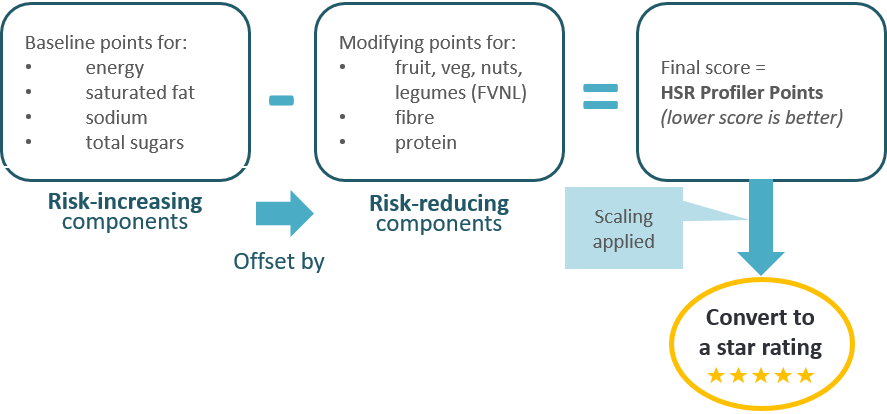
It isn’t about the number of ingredients or how processed they are, the system was never intended to cover that. It aims to provide a simple overall nutritional profile. I don’t believe that it is possible to reflect every dietary factor in a single index number. Nor do I expect to get 100% acceptance of any system as people have divergent views on what constitutes good nutrition.
From Food Standards Australia
It is about presence and amount of a number of key ingredients such as fat, sugar, salt or fibre. Butter is 80% fat and has no fibre. Frozen chips are about 6% fat (depending on brand) and contain some fibre.
All of which is complex enough without the extra dimensions that you want to add.
The reason vendors don’t want to make it compulsory is so they can hide their worst products by not rating them. Even if it is made compulsory there will still be anomalies and absurdities. The real question is not how to make a perfect system that all would agree on and that covers everything, but whether having a passable system is better than no guidance at all.
Personally, I believe people should have enough common sense to figure out what’s healthy and what’s not… people who are interested in what’s healthy don’t need to be guided by a frankly dubious health star system, the rest don’t care if it’s healthy or not! So basically it’s a big waste of time. Most people aren’t going to go into the intricacies of how the stars are allocated, they just look at the ratings and think, as an example, oh, frozen chips are quite healthy and certainly better than butter. I never buy it but I bet margarine gets a better rating than butter and clearly it’s not healthier to eat margarine.