Wondering if anyone has seen, and has views on and photos of, the electronic shelf labels Woolworths is trialing in some supermarkets as replacements for the paper special offer labels?
Apparently they are the same size as the regular paper shelf labels, so much smaller than the paper special offer labels, but have a yellow background.
I’m particularly interested in whether the unit price (or if it’s a multibuy special offer the unit price of the offer and the price of just one item) are sufficiently legible, prominent, and close to the selling price.
Also, interested in the location of any trial stores in the Brisbane area so that i can check them out…
6 Likes
Saw these in Canada in 1997 and they worked very well. They’ve had a long time to perfect them.

2 Likes
They are used in various stores (large and small) in many overseas countries quite successfully. Can’t see any problems here.
3 Likes
I mainly want to make sure that it is easy for shoppers to notice and read the unit price. If the available space is small the print size used for the unit price may be reduced. Plus, there needs to be good contrast between the print and the background and the info needs to be readable when viewed at an angle.
The e label technology has improved greatly in recent years and large labels are now available (but are expensive). So hopefully the labels Woolworths will use will be OK.
I think the trials have ended and the labels will be progressively introduced into stores. I’m expecting to be able to assess them in a local store during the next few weeks.
I have seen news items about negative consumer reactions in the trial stores. The main problem reported was that the e labels (which are only being used to replace special offer paper labels), were much less noticeable than the paper ones.
The advantages over paper labels seem to include: no need to print new paper labels and replace old ones, and less differences between the prices on shelf labels and those charged at the checkout.
2 Likes
I suppose it depends on what type and how much Woolies wants to spend. I’ve seen a range from basic grey LED signs where it would be difficult to see unit pricing to larger multicoloured signs (that are better than our current paper based labels) where the unit pricing would be obvious. I’m pretty certain none of the ones I saw overseas had unit pricing displayed on them.
It would be good if there was an Australian standard mandating the minimum size, colours and what is shown on electronic shelf labels before each store starts doing their own thing.
2 Likes
It would be interesting to know if anyone with polarised (slightly tinted) prescription glasses has had trouble reading the LED labels. It is possible they will appear black when looking through such glasses.
2 Likes
Several references say ESL uses LCD or e-paper, others say LED. So I expect readability issues will depend on which it is.
If it is LCD I have seen a problem, which may be the one you describe. If I wear polarised sunglasses some of the LCD displays in my car are very hard to read due to colour fringing. I am unsure if that is due to the LCD itself or the clear plastic cover.
3 Likes
Yes, it is the LCD crystals that are an issue. Some are backlit LEDs etc, and I possibly erred in the earlier post as any label with LCD display of any format would have been better description.
3 Likes
They are widely used in some EU countries where provision of the unit price is compulsory. However, often the contrast is so poor and print so small that it is NOT very easy to notice or read the unit price.
An Australian standard would only be useful if:
- it specified minimum requirements for the factors you mentioned or that the print has be able to be read at normal viewing distance at least by a person with normal visual acuity. AND
- compliance with the standard was required by the Code administered by the ACCC which currently only requires that the unit price be prominent, legible, unambiguous and close to the selling price.
There is an ISO Standard, that I helped to develop, but it is only a guidance standard that contains many principles to be followed and objectives to be achieved, but does not contain any minimum print sizes, etc.
5 Likes
Several references say ESL uses LCD or e-paper, others say LED. So I expect readability issues will depend on which it is.
wikipedia says:
Electronic paper (E-paper) are sometimes referred to as electronic ink or e-ink. It describes a technology that mimics the appearance of ordinary ink on paper. An e-paper display is made up of capsules in a thin film, with each particles within the capsules emitting a different color and different electric charge. Electrodes are placed above and below the capsule film and when a charge is applied to an individual electrode, the color particle will move to either the top or the bottom of a capsule, allowing the ESL to display a certain color.
When I go to look at the Woolworths e labels, which I assume/hope will be e paper ones not LCDs, I’ll make sure to also look at them through polarised lens to see if there are any problems with using them.
3 Likes
One technology supplier provides examples of their product. Mentions also case studies of a number of Australian retailers. Useful in it demonstrates some interesting large format label options.
https://www.e-label.com.au/solutions.html
There is a supermarket chain mentioned, but not Woolworths. Looking to the 7-News examples, not that great if this is the size of the label. There are better choices available?
2 Likes
Clearly there are much bigger possibilities but will they be employed by woolies?
I thought the link you gave had some interesting information. At least some models are capable of video and sound. The idea of 100s of labels chattering away every time a punter walks by or when tapped by a small child fills me with dread. Can they be turned off in bulk for ‘quiet hour’? I might take up shopping at odd hours.
3 Likes
This is a two-edged sword though.
When barcodes were introduced, the deal was that if the product scans at a higher price than the shelf price then you get the item free (per the Scanning Code of Practice).
In the event of a dispute, it would be fairly easy to prove your case. Go back to the shelf with a staff member and point at it (and prove or disprove).
If the shelf price were to become a dynamic item then it would be harder to prove what the shelf price was at the time you selected the item. Do you have to photograph the shelf as you select each item? Noone is going to bother with that. Are shelf prices only allowed to change once a day at e.g. 2 am?
I’m not suggesting that any store operator is going to be unscrupulous, only that this technology is making it easier for the operator to be so.
(Worst case scenario: Checkout chick hits the “price check” button, which summons a staff member to go to the shelf and check the price, and hitting that button automatically synchronises the shelf label with the scanned price.  )
)
So coming back to the quoted text … yes, that could be quite right. Fewer differences - but not necessarily in the interests of the consumer.
On my old car, where the radio / music player was a traditional LCD display, wearing polarised sunglasses, the display would go completely black but only at the correct angle.
This is a well-known phenomenon relating to polarised light.
3 Likes
The technology is most likely to be linked to the store’s electronic pricing system, that being, what is rung up at the register will be the same as that displayed on the shelf - same pricing system used. This will potentially remove any mispricing in the future - with exception of manually marked down products (which are generally already excluded from the pricing policy).
Having two separate electronic systems would be a nightmare!
2 Likes
I regularly experience the management taking the signs off displays where the scanned pricing is incorrect. One could wonder why? No evidence no problem? Trust is paramount.
2 Likes
Oh, yes, in theory. But imagine if there is an update to a price in the central system but for some reason there is a glitch and, when that update is pushed out to the shelf display, the update on the shelf fails. It takes some minutes (or longer) before the staff notice that the update has failed. In that time, customers can see the erroneous price but, by the time the customer gets to the checkout, the failed update has been fixed, retried and has succeeded.
The SoC microcontrollers in these electronic shelf labels can be fairly constrained environments, encouraging the cutting of corners in the implementation i.e. bugs e.g. one I looked at has a 38.4 MHz ARM CPU with 512 kB of flash storage and 32 kB of RAM. Let those numbers sink in for a while. 
They are prioritising exceedingly low power consumption and hence long battery life (ca. 5 years). (As that’s the same make of CPU that is in a Raspberry Pi, you can do your own calculations for how much more capable a Raspberry Pi 4 is compared with a shelf label.)
The label spends almost all of its time in an ultra-low-power sleep state, and Wakes-on-WLAN when there is an update. The eInk display requires almost no power because, unlike regular display technologies, it doesn’t have to be refreshed and it doesn’t emit any light.
Putting that aside, imagine if there is an update to a price in the central system and it is successfully updated on the shelf … but after you picked up the item.
I know what you mean but ultimately it is thousands of systems - one central system in the store and every single label is a separate, dedicated computer system.
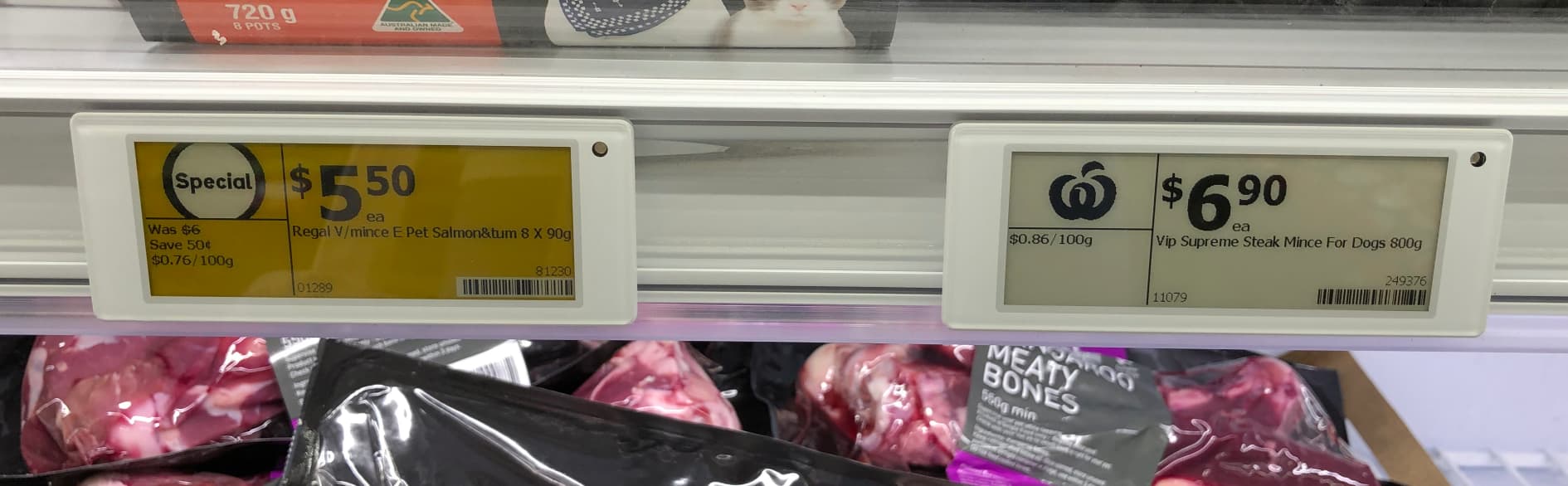
I took this photo last year as I was fascinated to see them in a Sydney Woolies. I thought they worked really well.
I have noticed that they put paper for the specials in the freezer section recently over the electronic ones, not sure if it was to help highlight. I found once you knew yellow backround was a product on special it wasn’t hard to notice them.
4 Likes
Another angle on this whole discussion is the privacy implications.
For those store operators who are prepared to use a bit more power and sacrifice a bit of battery life, the shelf labels can be programmed to track you as you move around the store, using either NFC (Near-field communication) or, perhaps more likely, BLE (Bluetooth Low Energy) or both - assuming of course that you are carrying a smartphone and it has one or both of those functions and one or both is enabled.
The goal from the store’s perspective is studying what promotional material captures shoppers’ attention, for how long, which are the popular aisles, what path shoppers take through the store, etc. etc. etc.
(Larger stores, like department stores and whole shopping centres, have been doing this forever, using WiFi - but that is less precise than the above two RF technologies, and potentially more expensive in equipment.)
In the longer term, supermarkets could do more creepy things like offer you personalised discounts based on what you looked at but didn’t buy (personalised pricing generally).
So the moral of the story is: if you don’t like that sort of creepy #$!^ then turn off as much of these technologies on your phone as you can (really when you leave your house but at least when you enter a shopping precinct).
2 Likes
Rather than speculate and encourage paranoia, what features do the suppliers of the label technology promote?
One site suggested the E-ink devices are low power and run off a built in battery. They hardly have the capacity to be continuously monitoring every nearby device and communicating the same?
The capabilities you suggest might be possible with some of the devices. Assuming a store has a higher powered active label, is customer tracking legal without a consumer opting in? It seems a bit fanciful, given at anyone point in the biscuit aisle there will be tens of nearby labels. Equally confusing will be those like me who stand back on the opposite side of the aisle to better see the product choices and read the labels.
One has the option when at Westfield etc to install their free App and enjoy the free wifi offered. If not just turn your phone off while you ponder the legality of the store tracking you by your facial biometrics. Far more useful in the biscuit aisle to read your facial expressions than Bluetooth track your mobile. 
1 Like
Many thanks for posting these. I have still not been able to see them instore myself. It will be interesting to see if these are also rolled out widely. I’ll reserve final judgement until I can see then myself in situ but I am concerned that the print size used for the unit prices is very small absolutely and relative to that used for the selling price.
3 Likes
