Ultraprocessed Foods (UPFs): Not good news

More and more information is being published about diets containing UPF. It is known that UPFs aren’t good for one’s health and a diet containing these foods can cause many health conditions, including early death.

The American Medical Association has stated:

consuming ultraprocessed foods on a regular basis increases a person’s risk of health complications including cardiovascular disease, certain cancers, obesity and type 2 diabetes

The challenge for many consumers is knowing what UPF products are. Many consumers find it challenging identifying UPFs. This is what they are:

In simple terms, it is a product which doesn’t look like its original ingredients, and/or contains ingredients one wouldn’t have in the pantry at home.

If one has time, it is worth watching:

as it highlights the tactics used by UPF manufacturers.

UPF manufacturers principal drive is to maximise profits, increase market share over competitors (including fresh, healthy foods) and to get consumer buying and eating more of their products.

They do this by:

  • making their products smell, sound, look and taste good;
  • making them easy to eat, convenient and readily available;
  • employing strategies to make their products appear healthier than they are; and
  • developing products that specifically encourages overconsumption

They aren’t interested in making healthy products or products which serve the interests of consumers.

Do you know what UPFs are and do you buy them?

Have UPFs impacted on your health or are you concerned about consuming them?

You are welcome to post your thoughts on UPFs below.

4 Likes

Indeed. And because it’s hard to pin down a definition of “ultra-processed foods”, how useful is it to the average consumer to say they’re bad for our health without providing clear instructions for identifying them?

What consumers need is help to spot ultra-processing via ingredients lists.

For example, what types of additive would identify a “mass-produced packaged bread” as ultra-processed? Colouring, perhaps, to make a bread look like, say, a traditional dark rye without all that faffing about with long slow cooking? Flavouring, to make a bread taste like sourdough without a sourdough starter and a slow rise? Sugar, to make it more appealing to those with a sweet tooth and encourage coming back for more? And so on.

3 Likes

In my opinion, some foods are very obviously ultra-processed – for example, all the ones that are synthesised to look, taste, feel, and have nutrient content similar to something they’re not. They’re usually “plant-based” items masquerading as animal-based foods, made from substances (such as proteins) extracted from various plant products and/or created artificially, adding vitamins, minerals, and other chemicals such as colouring agents, flavourings, salt/MSG, etc.

Fake meat is a perfect example. From The Conversation article Is fake meat healthy? And what’s actually in it?,

… a myriad of additives are needed to make these products look and taste like traditional meat.

For example, chemically refined coconut oil and palm oil are often added to plant-based burgers to help mimic meat’s soft and juicy texture. Colouring agents, such as beetroot extracts, have been used in Beyond Meat’s “raw” burger to mimic the colour change that occurs when meat is cooked. And the additive soy leghemoglobin, produced by genetically engineered yeast, has been used to create the Impossible Foods “bleeding” burger.

The bottom line is most fake meats are classified as ultra-processed foods.

They have undergone extensive industrial processing and include substances of “no or rare culinary use”, which means you would not find them in your average kitchen cupboard.

Much is made of the fact that such products are plant-based … but any relationship with the real plant matter is a very distant one.

Much healthier to learn to make your own plant-based meat substitutes from natural or minimally-processed plant foods. For example,

1 Like

By that definition it’s not only the fake ‘I can’t believe its not (pick your animal based product)’ * that could be called an UPF.

What about pork sausages- they look nothing like the original ingredient, IE a pig (and perhaps a tree for the sawdust!) :wink:

Steaks or chops look nothing like cattle or sheep either. Does cheese look like milk?

I don’t think anyone keeps livestock in their pantry.

I think the above definitions need some revision.

  • I have no idea why people want to eat those fake meat products! I’ve had a vego + fish diet for over 35 years with no desire to eat the fake stuff
4 Likes

I take your point. But, good quality sausages made with mince (meat only), salt and herbs still looks like the meat it comes from, only semi processed into the shape of a sausage. Compare this to factory/supermarket cheap sausages where the internals looks nothing like meat and contains a lot of ingredients which a local butcher wouldn’t add. This is an example where the ingredients are:

INGREDIENTS: No Added Hormones Australian Beef (58%), Water, RSPCA Approved Australian Chicken (15%), Rice Flour, Salt, Bamboo Fibre, Mineral Salt (451), Preservative (223 (Sulphites )), Thickeners (401, 412), Acidity Regulators (330, 270), Hydrolysed Maize Protein, Dextrose (Maize), Firming Agent (509), Vegetable Powders [Onion, Garlic], Spice Extracts, Spices, Natural Colour (Paprika Oleoresins), Rosemary Extract.

These are UPF and the ‘No Added Hormones’ and RSPCA Approved’ are specifically there to make them sound healthier/better.

No, but we don’t use livestock as a whole ingredient usually, unless one is possibly doing a spit roast or cooking the whole animal without fur/scales/feathers (viz. whole chooks, rabbits, fish etc).

The comment was made as UPF contain ingredients which one doesn’t use when cooking from scratch at home. Using the above sausage example, one’s panty doesn’t contain ingredients such as:

Bamboo Fibre, Mineral Salt (451), Preservative (223 (Sulphites )), Thickeners (401, 412), Acidity Regulators (330, 270), Hydrolysed Maize Protein, Dextrose (Maize), Firming Agent (509), Vegetable Powders [Onion, Garlic], Spice Extracts, Rosemary Extract

Having many non-pantry items is a dead giveaway to being UPFs.

The documentary on SBS has a startling example of a cake, comparing ingredients used for home baking and then used for a factory made cake (which is UPFs).

I did hear an alternative example by a nutritionist recent that products around the outside of a supermarket are generally non-UPFs, while those in the centre are generally UPFs. This isn’t a good definition either as there are often UPFs around the outside (fruit yoghurts, processed meats, frozen sections with icecreams, desserts, pies, pizzas etc) and the middle containing many non-UPF raw ingredients used in home cooking.

The definition about not being in ones pantry (and fridge) is possibly better as one can easily identify those ingredients which one doesn’t use at home. It however assumes that one cooks from scratch and uses raw ingredients.

2 Likes

True. And the fact that a lot of people apparently don’t cook for themselves makes it more challenging to educate them about UPFs. If they never cook for themselves, ‘pantry items’ don’t exist, so they might not be able to tell which ingredients are ‘normal’ and which ones could signal ultra-processing.

3 Likes

Unprocessed: an apple serve it as it is, as fruit.
Processed: make an apple pie with it, be moderate with the amount of fat, salt, and sugar you add.
Ultra-processed: add to the apple pie a good dose of fat, salt and sugar, some preservatives, colour, flavourings, emulsifiers.

Processed foods have been with us a long time: salting, curing, smoking of meats; cheese making; yogurt making; baking…
Ultra-processed have taken centre stage now as busy people look to fast-foods, long-life foods, and ‘time savers’ ready-made foods.
Flavour enhancers, preservatives, emulsifiers, colours, sugar, fat, and salt make those foods tastier, more appealing, but generally unhealthy.

My shopping guide is the same one as always, I avoid processed meat, chicken, fish. Don’t know what exactly is in processed chicken breast or in fish fingers or in chicken nuggets so I don’t buy any.
I keep an eye on the labels as to the percentage of saturated fat, sugar, salt, in any food in cans or in jars. Have noticed that Low Fat usually means it’s high in salt (cheese) or in sugar (ice cream), and ‘salt reduced’ usually goes with high in fat.

To sum up, it’s really up to the consumer to be ‘informed and aware’, although it does make it more difficult to shop when surrounded by enticing, time savings items in our busy modern life but our health is too precious to risk.

4 Likes

UPF goes along with ‘Convenience’. Convenience became important when time became a critical resource (like both of a couple working full time to pay tan ever-increasing mortgage). No time left to prepare meals from scratch. Is this co-incidence or part of a clever plan?
“Cui bono” the Latin language asks - who benefits? Certainly not the working couple, not the kids either. You are smart enough to work out who really benefits.

2 Likes

It does for some UPF, such as instant type microwave meals where the effort is limited to placing into a microwave and pushing a button. I personally believe that in most cases claiming it is convenient or easier may be an excuse.

Take fast food, which a lot is UPF, as an example. Unless one lives next door to the outlet, by the time one locks up, hops in a car, goes to the outlet, returns home, unlocks the house and then gets ready to eat, this isn’t a short period nor convenient (esp. if there is traffic or waiting time as it is peak hours at the outlet). A simple home made meal could have easily been prepared is the same or lesser time.

A lot of UFC which can be readily bought at Aldi (which has the least healthiest products), Woolworths, Coles and other supermarkets still require some level of preparation. Whether this is making a meal from scratch using UPF or cooking UPF components separately an then making a meal from that which is cooked (example being sausages, hash browns, gravy, corn ribs and peas). The time saving or convenience of cooking good, healthy food doesn’t exist. Such food selection is choice or possibly not understanding what UPF are.

If one snacks on UPF between meals, it is as easy to snack on other healthy alternatives which are just as convenient and available (handful of nuts, piece of fruit, slice of cheese from a block etc).

The only ones who benefit are the manufacturers, and secondly, the retailers/supermarkets. The manufacturers as they bulk out food that they produce with cheap ultra-processed fillers, to increase their margins and profits. Retailers/supermarkets as they often discount (such as 2 for 1 or half price) as the manufacturers can agree to reducing their own margins to increase consumption, and increased consumption in the longer term means more it bought. The more bought, more traffic to the supermarkets and more cashflow and potential profit margins for the supermarkets.

The consumer and health system definitely don’t benefit, as they suffer the consequences of diets where UPF are eaten regularly.

2 Likes

And sugar free means it possibly contains chemical sweeteners

3 Likes

Indeed! I was surprised just recently when drinking a ‘zero sugar’ cola how sickly sweet it was. (Aspartame if I remember rightly.)

2 Likes

And the news isn’t good for UPF containing artificial sweeteners:

Eating high amounts of ultra-processed foods (UPFs)—particularly those containing artificial sweeteners—may increase the risk of developing depression, according to a new study co-authored by researchers at Harvard T.H. Chan School of Public Health.

Media release:

Harvard T.H. Chan School of Public Health research letter:
https://jamanetwork.com/journals/jamanetworkopen/fullarticle/2809727

2 Likes

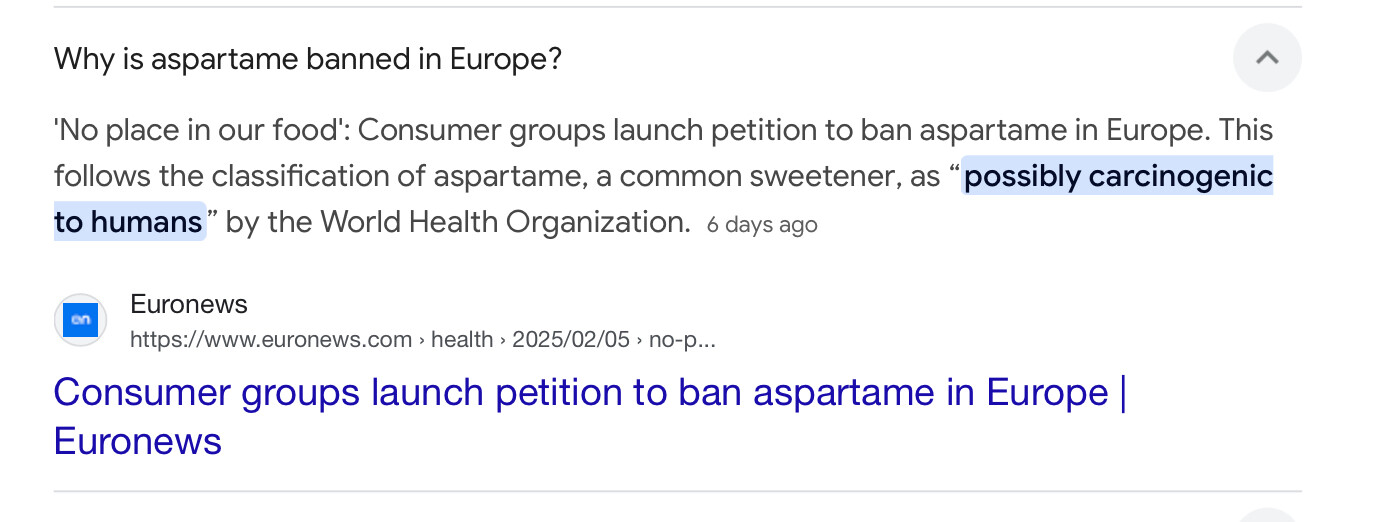
On the artificial sweetener Aspartame:


2 Likes

I have always had a tendency to use fairly basic ingredients. However, I have recently started on a carnivore diet. While I not aware of any prospective randomised studies there seems to be a slowly increasing number of reports on the health benefits of a carnivore or low/very low carbohydrate diet. In a couple of weeks I have already lost 3kg. I’ll be interested to see what my blood profile is in a few weeks time.
I do find it hard to have no carbohydrate but I’m told I’ll get used to that, and if some of the reports are to be believed the end result is very beneficial.

1 Like

High protein diets also have issues for us. One being as we get older and/or have impaired kidney function the load imposed on the kidneys by high protein lower carb diets is not at all ideal.

From the following article comes a warning as well about the ‘caveman diet’

As Willett explains, this is largely because of the saturated fat and cholesterol that’s found in animal (and thus meat) cells. Plants, however, contain more unsaturated fats, fibre and healthy phytochemicals such as flavonoids.

This means that going ‘full caveman’ and ramping up your red meat consumption is likely to greatly increase the risk of cardiovascular disease and reduce your life expectancy – especially if all those sirloin steaks are replacing whole grains and healthy plant oils in your normal diet.

1 Like

Yes it does increase the renal workload and that’s why you need to substantially increase your fluid intake and NOT do this without supervision to keep an eye of your physiology.

And it isn’t only adults which UPF are marketed to:

The ABC article raises the point made above that food manufacturers are:

The UK First Step Nutrition Trust has looked into the same toddler foods which are produced by multinationals and also available in the UK. Their report ‘Ultra-processed foods (UPF) in the diets of infants and young children in the UK’ is worth reading is one is concerned about toddler UPFs or is a parent of a child. The recommendations in the report apply equally to Australia.

2 Likes

And the bad news continues:

There has been a significant recent increases in bowel cancer incidence in 12-24 year olds. Once thought of mainly being an ‘older persons disease’, bowel cancer is becoming more prevalent in younger generations"

This means that one in 10 new bowel cancer cases occur in people under the age of 50.

RACGP - Bowel cancer incidence rates up 266% among 15–24-year-olds

Bowel Cancer states that today:

It is a common misconception that bowel cancer is ‘an old person’s disease’, but the reality is early-onset bowel cancer is on the rise and you should never be told that ”you’re too young to have bowel cancer”.

Although the majority of newly diagnosed bowel cancer cases occur in people aged 50 years and over, 1 in 9 (11%) Australians diagnosed with bowel cancer are under the age of 50.

1 Like

The American Heart Foundation have released a new study about UPF (Ultra Processed Foods). Most are not good for our good health. The study however does say that some foods that are labelled UPF may be beneficial. I have included an article about the study and a link to the study. It remains true that the vast majority of UPF should be avoided.

https://www.ahajournals.org/doi/10.1161/CIR.0000000000001365

1 Like

US bread is so sweet! I was there for 3 months before I finally found an Italian bread shop in Newport (RI), where I could buy bread rolls with no added sugar. Yikes. I was also fascinated by the breakfast food supplied in hotels and motels… always sweet rolls. So the article from the American Heart Foundation does not surprise.

2 Likes