In the latest mail out there updated toilet reviews. Silly me I thought the toilet reviews might be about finding the best toilet, alas its only about the water efficiency of the toilets. I bought one of the highly rated ones in a previous review and ended up with an item that doesn’t do its flushing job. Tried all sorts of work arounds but sometime or other I am going to have to replace it if I want the essential feature of a toilet.
2 Likes
I’d be interested to know which toilet you bought that’s been so unsatisfactory.
If that same model is still in the updated CHOICE review, you should add a review to it and explain the problems you’ve had.
1 Like
I have a little difficulty imagining designing a test regime to measure toilet flushing performance. I suppose it is possible to have a standardised, I am not sure how to put this, a standardised performance load. I am assuming here a synthetic test not a genuine effort for every test which cannot be standardised. How adhesive is realistic? Should there be floaters that have to be sunk or not?
Then there are the costs. If you were going to put all 429 through their paces it would cost a million dollars just to buy and install them.
You would have to have a small warehouse to accommodate them before the hundreds of metres of pipes for water and effluent. Some require power and /or hot water as well. Then there are all the combinations of pedestal and tank and seat that are possible to consider. Plus of course the cost of actual testing.
It’s an enormous project. I suspect rather beyond the capacity of Choice unless limited to the top 20 models and that may not be enough to please given the very wide range of candidates.
2 Likes
Many years ago, I was assigned to help computerise a company’s production system. I worked with two value engineers, one of whom once worked at Sankey, a well-known toilet manufacturer in England. The topic of testing came up, and apparently they developed a contraption that dropped fake turds from a certain height to determine flushing efficiency.
2 Likes
Thanks for the comment it is an American Standard Studio Close Coupled toilet suite with a square tank
1 Like
I certainly agree about the magnitude of thoroughly testing numerous toilets. I wonder if there is much point testing water efficiency of toilets.
“S” or “P” trap?
Was it a new install or replacement, and if so what style/type was replaced?
Depending on how the toilet plumbing has been set out in the floor, close coupled “S” trap toilet suites may use a horizontal extension pipe to connect the bowl discharge to the waste pipe. This increases the possibility of paper and other contents not clearing the waste connection reliably.
Can we assume the cistern levels have been correctly set for the dual flush? Details usually supplied with the product user instructions. Although a reliable plumber would have checked the settings and flow.
S trap installed by a plumber as part of reno. To clarify the problem, clearing the waste from the bottom of the bowl is not the issue. The problem is waste is not cleared from the sides of the bowel particularly the back side.
1 Like
I know this is old, and I understand how difficult testing all of them for flushing efficacy, but scoring only based on water savings is a little useless (a toilet using 0 liters and flushing nothing would get top rating). It would be great to include -at least as other/not ranked properties- flush button sizes, seat thickness/contour, pan shape (D or elongated), depth&slope.
Interesting. I’m looking for a new suite and the advertising for the American Standard looks appealing. However, when I search around for reviews, there is a litany of them, complaining about inadequate flush performance.
I agree. After all, the whole purpose of these reviews is to properly inform consumers. Water‑saving is one consideration, but as a consumer I’m also evaluating a lot more than litres per flush.
For example, suitability for elderly or disabled users (pan height), noise levels (soft‑close seat, soft‑action pneumatic button, quiet‑fill diaphragm valve), ease of cleaning (rimless pan, skirted exterior), flush performance (including the pan material and interior glaze, not just the flush), flush-splashing outside the pan, and base and skirting profile so I can be confident the new unit will cover the existing footprint without needing extra painting or tiling, and don’t need to move the wall faucet.
These are all real‑world factors that affect day‑to‑day use, and they’re just as important as water efficiency when choosing a toilet.
1 Like
Well said, @margotk … I, too, am on the hunt. Being both elderly and large, its difficult to know what to get.
1 Like
All the best with your search!
If you can find a plumber who is experienced with toilet installation - or a supplier, they should be able to advise you on a suitable model.
I haven’t found anyone to advise me as yet - I’ve taken measurements and logged those in schema diagrams to help me on my search (e.g. as per below).
For the plumber I reached out to, he seems to be leaving the selection up to me, then he’ll supply and install it. I’m thinking of reaching out to a large plumbing supplier to advise me on product selection. However, if I use their time and energy to guide me, then I’ll be purchasing the suite from them rather than through my plumber.
I always check online consumer reviews (particularly ‘Product Review’) before making a significant purchase, because - for two of the suites that appeared to me to be sterling models - consumer reviews are scathing, complaining of poor flush performance and flushed water splashing out of the pan.
The existing toilet was installed around six years ago. I had hired a plumbing crowd to replace only the cistern with a larger unit. They recommended also replacing the pan seal, broke the pan (I don’t blame them for that, as these things can happen) and then did not give me any choice of a replacement pan and cistern – they just supplied a cheap and nasty unit. That toilet has remained an annoying artefact of my then-poor choice of plumber: the cistern is noisy, the flush mechanism clunks and the seat height is lower than the previous one (the pan height of 42cm is too low for a mobility-impaired 91-year-old member of my household).
If I dare venture into scatological considerations: some years ago, I had heard a theory that using a lower pan elongates the colon and helps with bowel movement. However, that does not seem to be the conventional wisdom these days. For my 91-year-old, I’m looking for a slightly higher pan (with a seat height around 46cm). These are referred to as ‘overheight’ or ‘comfort height’ and are more suitable for someone who struggles to get off the toilet.
Once the new toilet is installed, I’ll have a handrail or rails installed. I’ll wait for the toilet installation first, so the rail can be installed in a suitable position for him, relative to the toilet pan height.
There seem to be some effective rails that mount on the back wall, which can be folded up and out of the way when not needed. Some have an appealing white finish and a fluted texture to provide good hand-grip, though that rear-mounted option will be contingent on locating a wall stud in a suitable position to ensure a sturdy installation.
Below is the list of features that I’m using as a basis for my search. If I get a skirted model, the skirt can’t be too bulky as the wall-mounted faucet will be in the way. For that reason, I may need to go for a link suite.
Features:
-
Overheight
-
Soft-close seat
-
Soft-action pneumatic button and a Geberit-style flush valve that opens smoothly
-
Quiet-fill, diaphragm-controlled valve with soft shut-off
-
Powerful flush with good coverage
-
Rimless
-
Vitreous china - high-quality porcelain with a fused, high-gloss vitreous glaze
-
Gloss exterior (for easy cleaning)
-
Link plate or skirted exterior to hide the plumbing and for easy-cleaning (I’m not sure if the skirt needs to have an aperture in the side for the inlet hose).
I’m undecided about a round seat or oval seat.
I’m also checking dimensions including the projection (length of the entire suite from the wall) to ensure users can still comfortably and safely move around in the ‘smallest room in the house’.
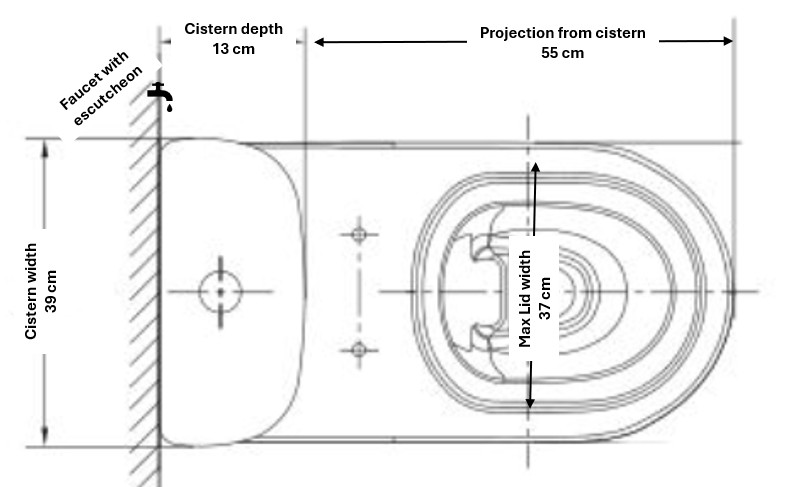
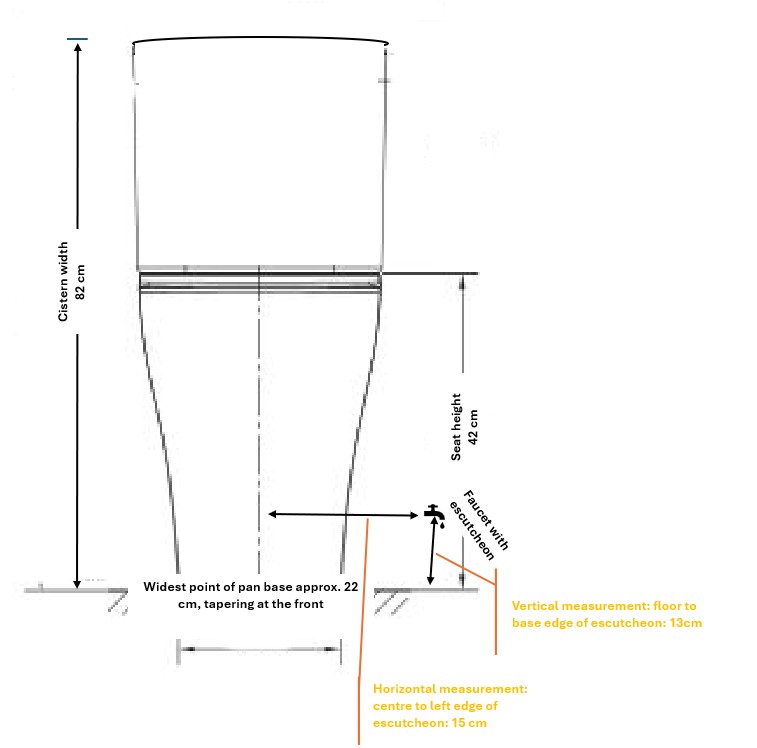
1 Like
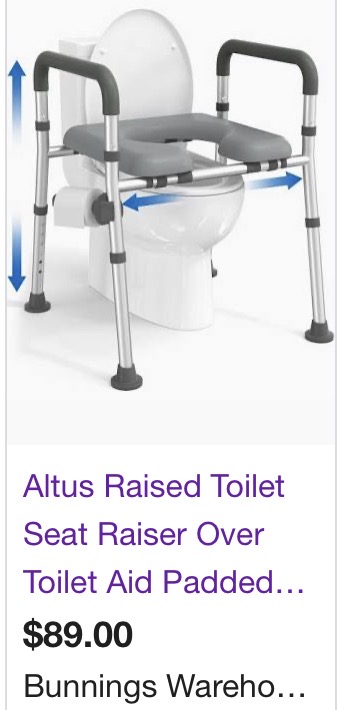
Later in life my mum suffered a broken hip (twice) and had difficulty sitting and standing on any standard seats, at the hospital they gave her a list of aids to make her life easier around the home. For the toilet they suggested a frame that sits over the existing toilet bowl.
Height adjustable, with arm rests, makes it easier to sit and to stand up.
It’s available from mobility equipment suppliers, pharmacies, even Bunnings.
The included photo from a Bunnings Ad shows what they look like, but there’s better looking and more expensive ones from hospital equipment shops.
Might be worth having a look so that the list of requirements gets narrowed down?
3 Likes
Perhaps this is what you are pointing to, and if not also available from the many retailers who specialise in selling home support/mobility aids for seniors/aged cared, NDIS etc. Two of our family used similar. Better if one can find a model with an extension that extends from the chair seat into the pedestal at least as far as the rim. Necessary to minimise the unintended escape of 1’s and 2’s, otherwise the prospect of a not so exciting chore of cleaning the regular seat, lid hinge area and floor. I recollect some can also be used without the seat provided (removable), and just as a frame to help with getting on and off.
