Right at the outset I am going to preface this with ‘I was raised by my grandparents who were born in 1911’.
As a child, raised in Southern England we had a fair share of storms. They were fascinating. Until my grandmother screamed at me one day with absolute terror in her voice - the sort of passionate, caring terror Mel Gibson had based a career upon ‘get away from the window, the lightning will get you’. 55+ years later and I still back away from the window and clutch my pearls should someone stray on the ‘other side of the blind’.
Is this a genuine fear? Can you get zapped by lightning through the window? And lastly, speaking of storms, will a tree branch penetrate your window, drag you through the pouring rain then attempt to devour you?
Answering your question, I would suggest almost definitely not.
The risks of standing near a window would be no different to standing somewhere else in the house.
Lightning is a electrical discharge. It will follow the route of least resistance. If lightning struck the roof immediately above where one stood, it will most likely follow a metal pathway to the ground. This will be roofing to gutter to downpipe, through electrical cabling or metal plumbing within the house. If the house has metal roof and external walls, being within the house is extremely safe due to the Faraday cage effect (just like being in a metal electric train).
If there isn’t anything conductive on or within the house, there is a remote chance the lightning might go straight through, irrespective of where one is standing. This is possibly only likely in dry storms, as a wet house/surface/water containing dust and salts would conduct the lightning.
I have been beside a window when lightning struck about 10 metres away. The metal fly screen gave a small electric shock as a current was induced due to the electromagnetic field created by the lightning bolt. The other impact was being startled by a bright flash and deafening thunder at the same time.
Dear PHB, thankyou so, so much for your informative response, I can’t thank you enough for allaying those fears and will certainly read further into the cage effect. Without wishing to refer to ‘old wives’ tales’, my great grandparents would’ve instilled this into my grandparents. Their origins are dairy farmers in Devon, England in stone houses with dirt floors and thatched rooves, absolutely on point with your response. Again, thankyou, I really appreciate such a factual and informative response. Ten minutes later, am now addicted to science.howstuffworks!
There may still be a basis to the paradigm or “sage saying”. Advising one to stay away from windows during a storm may have been wisdom for other reasons. The choice of lightning a way to add dramatic effect and fear to ensure observance. To note a significant proportion of the glass used in windows in the past was relatively thin (3mm or less). Very prone to break into sharp shards if hit. Possibly due to wind blown twigs/tree fruit etc, the wind itself and … Lightning also delivers other than an electrical shock risk a substantial explosive blast in close proximity.
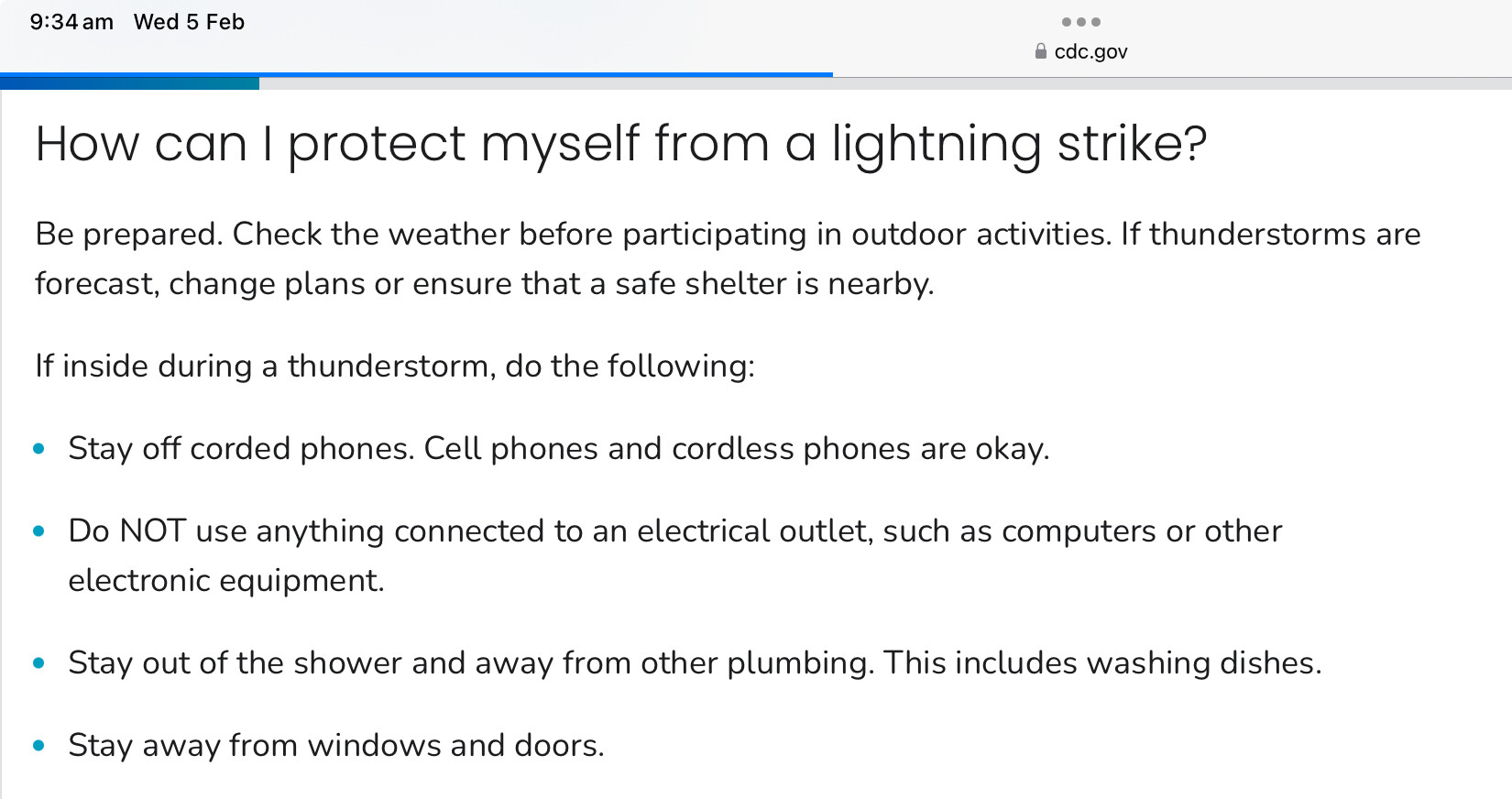
There is also sound advice re cyclones and tornadoes about where to shelter. Next to the window of the home not one of them. Although for reasoning other than avoidance of a lightning strike. The US CDC suggests somewhat differently:
Staying away from windows may not be due to a lightning strike per say, but, the potential shattering of the window from the thunder caused. There are reported cases where windows have shattered from the ‘shock wave’.
The chance of lightning going through glass is low (or possibly not much different to standing elsewhere in the residence), as the resistance of the glass as well as pathways to the lightning earthing would be less than the lightning flowing around the exterior of the building or direct to ground. It would be possible to set up an experiment with an earth against a window and inside the house to see what happens in a storm. It is likely that with a good earth immediately inside the window, the risk of lightning passing through the window (breaking it first) would be greater.
A greater risk may be in multistorey buildings where there is separation distance to the ground and the internals contains things which could conduct the electricity to ground (such as plumbing or wiring within the unit), but, this is also unlikely as multistorey buildings have lightning protection systems. These protection systems attract lightning strikes and allow the electricity to flow to ground. Protection systems can also be used on single or low buildings which have equipment sensitive to sudden bursts of electromagnetic fields. A previous workplace, even though the building was two storey with an exterior completely covered in metal (metal roof and exterior mesh), had a lightning protection system as the contents of the building were critical in nature and sensitive to electromagnetic fields. The discharge rods on the building had counters to record if and when a strike occurred.
Growing up we were told not to have a shower during a lightning storm. This is because if the house is hit and the lightning passes into the house, it could use the plumbing system for discharge. There is a every so slight risk if one is in the shower, the path of least resistance is from the shower rose through one’s body to the drain hole. Risks would be greatest if the wastewater pipes were metal.
These are extremely low risks. Statistics for death by various things has been recorded in the US which provides some grounding (pun intended) to the risks associated with lightning:
In 2023, there were too few deaths due to lightning to calculate any statistic. Things like riding a bike, having a bath or walking across the road pose far more of a risk…so why worry about lightning. Worry comes from fear rather than reality.
I luv watching lightning storms but if the lightning gets close I move away from the window.
I spent around ten years doing “impulse Testing” simulated lightning up to 800 kilovolts. Real lightning is well into the mega volt range.
Lightning does not always follow what most people consider the path of least resistance due to other factors including the inductance of a round wire v’s a flat wire. Lightning is attracted to sharp objects.
If your window is on the top level of a high rise unit block I would stay away from the windows. If you were on the lowest level of the high rise building you would be much safer.
Yes glass was used in insulators years ago but that was glass made for the purpose not the same glass as in windows and glass insulators cannot withstand a direct lightning strike, they are known to shatter. Also lots of windows have aluminum frames ie very conductive, as is wet wood.
As suggested by the person who thought they were close to a lightning strike there is also the risk from induced voltages as there is very high current flow. The majority of people who think they survived being hit by lightning were affected by induced voltages from a nearby strike.
I worked with a person who experienced about 87 000 volts from a lower energy source than lightning and luckily he survived but he was a several centimeters shorter when he returned to work many months later due to the damage to his spine.
If there are other higher things in the close area for lightning to strike you could also be ok but if your TV arial is close to the window that may attract the lightning, as would a metal roof.
If you live on a farm with no other houses close your house is more likely to be hit, that’s why outdoor sporting games are canceled or paused when lightning is around (even games at grounds with tall metal light towers also not a good idea to be in the ocean. From memory a lightning rod provides protection for a total of 30 degrees ie 15 degrees each side.
The shower thing is a real risk if you have pipes in the roof, when you are wet you are much more susceptible to electric shocks and the water not being purified would be somewhat conductive as is a concrete slab.
Also due to being wet any induced voltages would have more effect on you.
also the suggestion of putting an earth near the window is dangerous unless you use thick welding cable and stay well away from it due to the induced voltages.
And you are likely to destroy the equipment in your building as you will be raising the earth voltage .
The Lightning generator test equipment I used had its own earth rod in the ground and an isolation transformer supply. Even then it still caused damage to other equipment in the building occasionally. And the equipment had much less energy than real lightning.
A house is nothing like a farady cage and there is also a risk of induced voltages so it would also have to be and emf proof cage, much more complicated than a faraday cage. I know because I got my company to start doing EMF compliance testing and the EMF room was in no way a simple thing. It had thick metal walls and also had mu metal as at least one of the layers.
Also if the down pipe carring the lightning current was near the window you would be in trouble.
I was also involved in testing lightning surge arrestors and for that test I think 20kA (20 000 amps) was starting level for low risk equipment
That statement shows that lightning behaves different to normal 50hz electricity, the test lightning was 1.2/50 micro seconds ie from 0 to max volts in 1.2 micro seconds and then 50 micro seconds to zero, for testing surge arrestors it was an 8/20 wave form.
As indicated above, it is similar to electric trains which also aren’t a true Faraday cage. When a train is hit by high voltages (lightning or overhead cable failure), the current flows on the exterior as a result of the basic principle that electrons repel each other. This is why electric trains are electrically safe to travel in.
While metal structures exhibit some properties of a Faraday cage, they won’t shield EMF/EMR like a true Faraday cage. The discussion is about electricity (lightning) and not shielding against EMF/EMR.
From a private discussion about this topic is this post that may interest you.
In high conductivity conditions such as low resistance due to water or soil makeup, induced voltages can be high even if the strike was not directly on the cable area. Most studies have looked at direct strikes at the cable location or on surrounding connected structures, though some studies have looked at induced voltage damage through the soil.
One from Sweden might be worth a read. In this study it looked at damage that caused the insulation to fail and ways to attenuate the damage.
The lightning lore when I was a child was not to stick one’s head out of a window when ‘sheet lightning’ was around else risk possible decapitation… and my maternal grandmother would take the cutlery and place it under her bed during thunderstorms…However, even in science, new myths can easily evolve into ‘facts’ such as the one about White-tailed Spider bites causing flesh-eating disease.
I am often to be found under the bed in thunder storms! Do I have to worry about it being an old brass one?
The main thing we were taught to avoid was being on the telephone during a storm. Many horror stories of what could happen.
PS My grandparents were born in 1899. Survived WW1 and the Spanish flu. Everything seemed to be a terror to them. Even the TV had to be switched off in a storm.
That one is actually true. Landline phones were attached to copper wires strung above ground between poles, and it would have been dangerous to use the phone while a storm was around. A strike on or near any part of that exposed cable would’ve sent a large current spike through to the connected phone and into the person holding it.
TVs needed to be (and should still be) unplugged from external antennas during storms, because a strike on the antenna is quite likely, and would destroy the TV. Unplugging the TV from the power point – not simply turning it off – was also advisable, because a strike on or near the power line could fry something plugged into a power point, too.
I was standing at the open front door once when the lightning struck my house . My cow was standing a little way away by the paddock fence: she looked horrified (to me!)
I saw a large arc from the metal garage door frame to the end of a water pipe that was resting above it- it may have been in the opposite direction?
Needless to say I retreated into the house. Presently I smelt a brown smell and was concerned a fire may be starting in the roof cavity, so I went ip the attic stairs to check it out. Smell but no visible smoke.
About 30 minutes later the fluorescent light in the back kitchen started flickering, I went to the fusebox & turned off the power to the lighting circuit, then took a few tools back to the roof. Located the suspect light under the insulation & disconnected the wires to the light: I could feel a real hot spot in the antique pine lining boards where the light fixture was located, pulled all the insulation well clear and left the steps down so I could get back up quickly.
After an hour of no more drama I turned on the light circuit again so that I could see what was what. I was later told that the light’s ballast was cooked.
That was an interesting afternoon: closest I have ever been to a strike…
I remember people often mentioning fireballs, or “ball lightning”, when I was a kid. It didn’t seem to be because they themselves had seen it. Maybe there’d been a high-profile story about it?
It is real, but rare, and nobody really knows what causes it.
What Is Ball Lightning?
Ball lightning is a rare and mysterious form of atmospheric electrical phenomenon that appears as a floating, glowing sphere. Most report involve thunderstorms, but sometimes it appears in connection with other electrical events. Unlike the familiar streaks of lightning, ball lightning is a luminous, spherical or pear-shaped object. The sphere persist for several seconds. It typically measures between 10 to 40 centimeters (4 to 16 inches) in diameter, although there are reports of sizes ranging from that of a pea to several meters across. The color varies and sometimes the event produces a sound or odor.
…
[it could be] dangerous due to its unpredictable behavior and potential for explosive dissipation. There are anecdotal reports of harm from close encounters, ranging from minor burns to fatal injuries. If you touch it, maybe nothing happens. More likely, you absorb some of the energy and get shocked or burned.