Interesting results, but it shows how some things are impressions, not quite matching the facts. Under Network Coverage Belong gets 85% and Telstra gets 79% despite the fact that Belong uses the Telstra network, but not quite all of it, Belong claims to cover 98.8% of the Australian population whereas Telstra claims 99.4%.
I currently have a 2GB, $50 per month plan with telstra but need more data - say 40 GB. Any suggestions please
2 Likes
21 posts were merged into an existing topic: Best SIM only plan provider (to August 2024)
Recent Choice articles include
A new post in the Aldi Mobile topic caused me to look at current plans from a number of carriers. Anecdotally it seems the prices are going up, up, and up. Might this be what the market will bear in the advent of 2FA security and apps whereby the phone becomes an indispensable proxy for the customer?
4 Likes
An unscientific scan of mobile plans and especially prepaids, suggests that as with many other products there is significant price inflation.
My second sense is that as mobiles have become all but unavoidable for 2FA and needed for the ranges of ‘digital everything’ the telcos realise the market has to bear higher prices. In justification they are offering such perks as international calls, lots of texts, unlimited calls, and ever more data.
Those with modest needs are ‘not their target business’ unless the customer is willing to pay for ‘the lot’ on offer, needed or not. Comparisons are not encouraging when one only needs domestic calls and texts and a few GB of data per month, if that. PAYG when available has a generally high unit price for each service, yet still might be a good deal worth looking at when the all up expenditure is considered.
3 Likes
I conjecture that part of the price rises has been the greater penetration of the 5G network, not only because it is simply 5G as a new tech but it is the added cost of many new towers/access points and upgrading existing towers and other infrastructure to use that 5G network.
3G as outdated as it was, came with lower cost to provision as it was very mature tech, 4G similarly has some decent development and production history so costs become lower over time. Using the low to mid bands of the spectrum a 4G towers gets a coverage around 3 to 6 km, a 5G tower has around 1.6 to 5 km coverage in the same low to mid spectrum frequencies. A 5G small cell is around 15 to 600 metres. Small cell implementations are very useful for black spot coverage and super dense population coverage. We can expect as 5G ages in terms of production history, it will become cheaper. 6G when it becomes commercially advantageous, will introduce new cost pain and probably similar inflationary pressure on plan costs. We still have to contend with everyday inflationary pressures such as wages growth, typical cost of goods increases, and the need (and indeed desire) for profits.
Those figures are in general terms, a 700 MHz signal in a rural area could reach about 22 km of range. 600 MHz would have the best range, data carrying capacity though would be the lowest. Those distances are a perfect world with no terrain or other interference with signal travel. Nothing I have ever seen is so perfect, it is considered a tower reaches about 80 km2 (again in general). So it’s a trade off in distance with data.
In densely populated built up urban areas, a tower is probably required every 400 metres to 1.6 km. As our cities grow both upwards and outwards many more towers become needed.
Another aspect of the transmission coverage is the power used to drive the signals, in some cases the very high frequency signals are reduced in transmission power as they can interfere with certain bands that are used by military and others. Reduction of the transmission power reduces the coverage that is possible, so more towers to get the same coverage without interference of the other critical uses that higher power transmissions could interfere with.
2 Likes
My first reaction to that is lets charge everyone for 98 petrol because some cars need it  - and of course because ‘we can do it if we want’.
3 Likes
Coupled with the ever increasing desire for mobile data and population growth. To keep connectivity for many more users requires more cells. This circle of need (desire perhaps is the better word) and response only gets bigger.
If a user lived in a poor reception area (something you have mentioned previously  ), and a new tower could drastically or even moderately improve that, would that be the preferred outcome even with an added cost pain. Only each user affected could answer that for themselves, I wouldn’t impose my preferences on them. I suspect though that the Telcos have plenty of feedback that would, even if only minimally, encourage them to build more.
2 Likes
Tradition as I understand it is that business invests, sells, and reaps profit. Seems we are in a cycle of business raises prices, gets ‘paid’ for what they are going to deliver some day (or maybe not), and starts taking profit up front? In some places it is selling smoke since the signals have not improved in those grey and black areas.
3 Likes
I agree with what you have said. I think the larger improvements are occurring where most profit can be derived e.g., for CBD areas, densely populated areas (and I do mean dense). Keep the larger populations happy and tinker at the remaining edges. This means everyone pays for the increase, regardless of their personal circumstances. These circumstances cover cost, convenience, level of service required, level of service received.
It would be great that everyone had great reception, no one except perhaps Govt really care if there isn’t a profit in making it so. I do know the Federal Govt funds in partnership with Telcos a program to place more towers in areas that require them particularly remote and at risk areas. A program where my cynical nature says it benefits the Telcos, as they don’t have to fork out the entire cost of improving areas they should be required to do so in.
This is a map that shows areas eligible and ineligibile for Round 8 of the black spot program. It can be searched for addresses and areas and choices can be selected to show boundaries such as local Govt ones.
The map is part of the Project Noticeboard, and importantly it is
for local governments and state, territory and federal parliamentarians to identify potential projects or locations which would benefit from new and improved coverage.
Industry applicants will be encouraged to consider the proposed projects and locations on the Project Noticeboard when developing their applications.
It is important to note that posting on the Project Noticeboard does not guarantee that an application for funding for a project, or a project in the nominated location, will be submitted, or that funding will be allocated to the proposed project or location. However, it can help communities advise the industry of risks in regional, rural and remote Australia, and demonstrate support for new proposals.
The Round 8 Project Noticeboard will close three weeks after applications for Round 8 open. This will allow industry applicants time to consider advice provided through the Noticeboard and to engage with other applicants on the development of proposals.
At the nationalmap site there is more detailed map data available.
Select Map Data then Communications from the listing to see options.
3 Likes
Kogan mobile is currently expanding and upgrading their mobile service coverage.
I live in a rural location and up until 2 days ago my kogan mobile service was only useable if I drove into the nearby town.
However 2 days ago (15 Jan 2025) I noticed a sudden big increase in kogan mobile signal where I live. I thought perhaps I was dreaming until I received advice from Kogan about the upgrade and expansions.
Its made all the difference at my location.
Kogan mobile offer great deals.
I’m on 365 days unlimited calls and texts plus 500Gb data all for $150 when on special. Thats a winner deal and worth checking out if you now get Kogan service in your area. Vodafone network.
BB
2 Likes
The ACCC didn’t oppose TPG/Vodaphone and Optus to share infrastructure in some rural/regional areas to improve coverage. It appears that you may be in one of the areas where sharing has been carried out to the benefit of their mobile users:
It is positive that the ACCC didn’t oppose the sharing, as it provides consumers/their mobile users with better coverage than would otherwise be the case.
2 Likes
A good outcome for your situation.
This would be from an improvement to the Voda/TPG service. Kogan uses the Voda/TPG network, it has a smaller footprint than Telstra, Telstra Wholesale and the Optus networks As Voda/TPG expand their network there will be increased coverage. Similarly Optus and Telstra are increasing their footprints, and all of the Telstra, Optus and Voda/TPG businesses participate in the Federal Government’s Blackspot program which funds these improvements through our taxes, and not so much the profits of the companies.
3 Likes
Here is the message I received from Kogan this morning.
"Hi JoeBlow, we’re expanding our network across Australia, with coverage expanding from approximately 400,000 square kilometres to around 1,000,000 square kilometres. From 30 January, you can enjoy enhanced connectivity on a bigger and better network.
To learn more visit koganmobile.com.au/about/network-coverage-increase. From Kogan Mobile.
I suspect Kogan is sharing the Optus tower which I can see about 2 or 3 klms away as the crow flies.
Anyway it means Kogan mobile can now offer serious competition to those who would like to get away from being stuck with that other dogs breath of a corporation.
BB
2 Likes
I didn’t doubt that it was a Kogan Mobile announcement, Kogan Mobile as an onseller of TPG. A great outcome for you as you use the TPG network. Kogan in that regard do not themselves have towers, the towers are owned by Vodafone/TPG or a shared one with Optus. Kogan itself is an on seller of TPG, something like most pet insurance by whatever name e.g, RSPCA Pet Insurance is in reality part of the Hollard Insurance group. They are in that way a MVNO. Their claim is like a bit of puffery, in that sure the TPG network coverage has been improved, their payments received by Vodafone/TPG has meant more money could be spent on Vodafone/TPG network resources. Though in this case it is probable that it was under a mobile Blackspot program.
Kogan Mobile ownership and billing
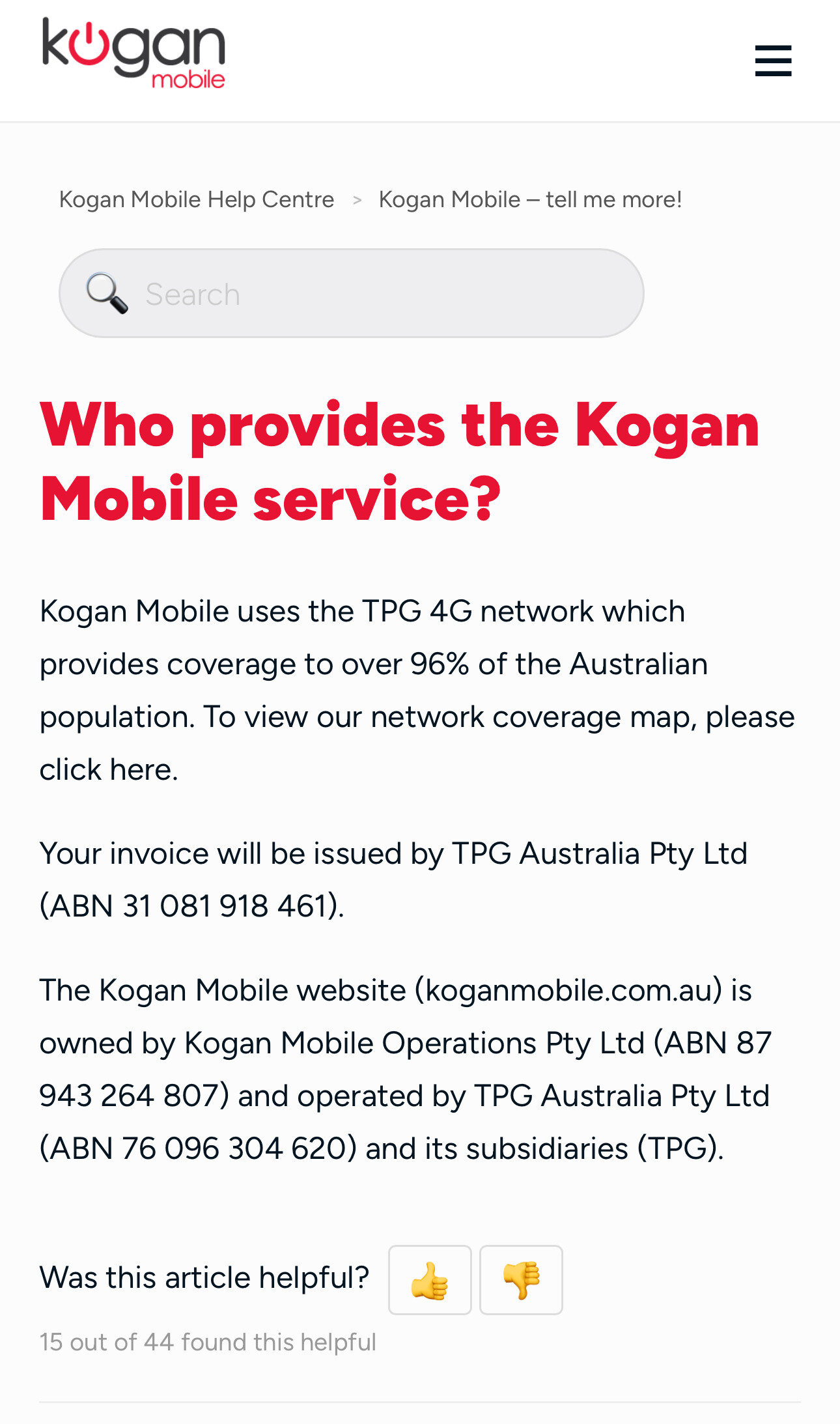
The Mobile Blackspot program is now into round 8, there are maps for the network and the eligible and ineligible areas under the Blackspot rounds. If it was part of the Blackspot program, your improvement was probably funded under round 7.
3 Likes
You might check whether in fact it is under a roaming agreement (but, as others have said, Kogan is completely irrelevant here as they own nothing).
That is the alternative to the possibility that TPG has actually added equipment to the tower.
You can of course check the national database to find your tower and see exactly who is using your nearby tower (mobile network operators, one two or three, and others e.g. NBNco, and for what purpose on what frequency).
1 Like
I checked the national database map which says that tower near me is used by NBN Optus and Telstra. But Kogan runs on the Vodafone network according to my understanding.
1 Like
There is an infrastructure sharing agreement between Optus and Voda/TPG. This could be one of those shared towers, as it also has Telstra and NBN co-located on it as well.
Is there another tower close by? It isn’t always the closest tower that you may be seeing your improvement from.
Another possible reason may have been reallocating of the old 3G bands to the 4G bands such as the 700 MHz one (this band is used by all the carriers now in 4G) which is the designated one for PPDR (Public Protection & Disaster Relief). This would also be seen as an upgrade to the 4G network.
1 Like
Has anyone been denied an offer as they have previously been a customer? With advice to switch at 6 months or less, I was wondering if eventually you end up going back to a provider you have been with before.
Telstra pricing for many internet and phone plans are Increasing on 1st of July by around $3 to $5. Some plans will remain the same and some plans particularly those high speed internet plans will see a decrease.
Telstra have created a web page about the changes
