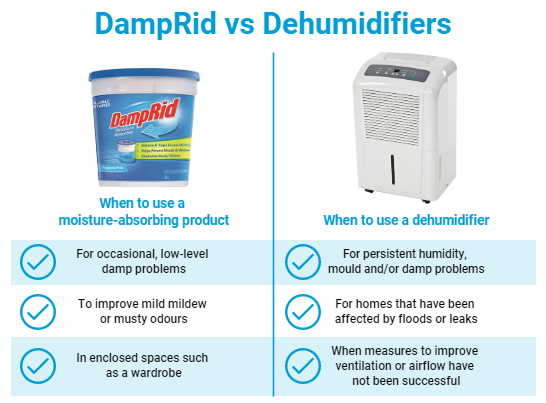
If you’re dealing with too much humidity in your household, supermarket DampRid may get you out of trouble in some situations.
If you’ve tried DampRid, tell us your experience in the comments below.
Read the full comparison here:
If you’re dealing with too much humidity in your household, supermarket DampRid may get you out of trouble in some situations.
If you’ve tried DampRid, tell us your experience in the comments below.
Read the full comparison here:
I use DampRid in wardrobes. It does seem to work and certainly sucks moisture out of the air.
I am a bit unconvinced that a dehumidifier is an environmentally sustainable solution unless you have excess generation from your PV.
There is a third option … when to get a plumber in. Sometimes persistent dampness problems are actually caused by a leaking pipe, leaking roof, overflowing gutters, poor drainage, etc. etc. etc. … and it would be better to treat the cause, rather than treating the symptom.
PS There’s a typo in the opening sentence of the first post in this topic.
We’ve recently purchased 2 refrigerant style dehumidifiers for our home. This followed experience with one over a couple of days in a local retreat, set in a damp rain forest environment. The owners relied on one in each cottage, in addition to having RC split systems.
With some similar challenges we’d relied at home on the canisters (with bulk refills of desiccant), and our RC air conditioners.
Where a canister might last several weeks and collect one litre over that time, the dehumidifiers can collect 4-7 litres in half a day. They have proven far more effective.
Our split system RC’s do have a dry cycle, but it does not seem as effective. A different discussion for the dehumidifier tests.
We have similar experience in using the DampRid type products and dehumidifiers as @mark_m.
We live in a subtropical climate, and have airconditioners, but only use them when the fans aren’t enough to keep the environment bearable.
Firstly, it is important to buy reusable DampRid or similar containers, and not single use. We had the containers everywhere trying to reduce the humidity in cupboards etc, and had to buy bulk refills of the desicant material on a regular basis. The DampRid works very slowly, and just can’t cope with the constant high levels of humidity that we have, so the containers need weekly tipping out of fluid and top-ups of dessicant. Thus it becomes a relatively expensive proposition, and doesn’t really work here.
One thing to be wary of with those: if the container’s contents spill for whatever reason, it leaves an oily-like residue that stains porous surfaces - forever!
We now have two large dehumidifiers, and if windows have been open they easily fill their containers (4L+) every day. If we keep the windows closed, they gradually harvest less and less until the windows are reopened. Fortunately, they have auto shut off if the water container is full so they don’t overfill. The water collected is clean, so it doesn’t matter if it spills, and we use it to water plants.
Good point. I haven’t experienced staining but the residue is difficult to remove.
Nice!
Use the DampRid in wardrobes (ever since I opened one unused wardrobe to find mould growing on the few clothes left in there). I now leave the wardrobe doors open to improve airflow. Had one container crack, it leaked! Since then I now place the product in a plastic takeaway food container (if the container leaks the liquid should be caught). Thought I’d dealt with the damage at the time but we’re now in the process of replacing the chipboard shelf, due to the fact it has expanded and is breaking up thanks to the oily liquid.
When living in Sydney I used DampRid in my piano (seemed like a good idea), wardrobe and linen press. It certainly collects moisture.
There is no doubt that Damprid will absorb water from the air. The problem is that unless it is in a closed container it will absorb moisture from the air until it reaches its limit and then you are left to dispose of the residue and, if you want that area dried out more, you have to replace the Damprid. As members have shown from their experience this can get tedious and expensive.
If you want continuous drying in a large volume the product is not going to be very cost effective. If you want to dry out an enclosure or have a temporary problem it may be a reasonable solution.
The alternative of refrigerative dryers is going to be more cost effective when the source of moisture (like open windows) is continuous. To say whether this solution is more or less environmentally sustainable would require costing the alternatives. Using power to run an electric dryer that may generate greenhouse gases is only part of the equation.
A word of warning, desiccants can over-dry wooden artefacts. This may cause damage to musical instruments, furniture or statuary, for example. Some of these items could be worth much money.
There are cases where sucking up the moisture by any means is not effective. Take the case of a new (a couple of years old) home unit. It was part of a huge complex that stepped down a hill, the design made use of a difficult site and gave many of the units a view. The problem was the construction was shonky.
The unit backed on to the excavated rock face. This meant the rooms at the back had no windows - apparently in some cases this is acceptable to building standards. Having little air circulation the back rooms had exhaust fans. The fans and/or their tubes were ineffective, in one case the flexible tube was crushed so the fan could whirr all day and do nothing. The owners put a dehumidifier there which reduced, but did not remove, the tendency for all to grow mould. While getting some repairs done it was possible to get a peek at the area behind the back wall. This consisted of the sandstone cliff about half a metre behind the concrete wall and water ran out of the cliff constantly. The back wall was not waterproofed and it was always wet. This soaked through to the the point where you could see efflorescence amongst the mould. No amount of desiccation was ever going to fix the problem.
The owners were already hip deep in conflict with the builders over many problems, and enforcement of standards is so lax, that another major battle was going to be uphill. They got the builder to patch up the visible problems and sold as fast as possible. Caveat emptor.
Thanks for the tip about musical instruments. I’m back down in Melbourne where humidity is not as much of a problem.