I purchased a new Audi A3 in May 2022. Lovely car. Very happy. Nice features. Last year some of the functionality stopped (map updates, map visuals changed - no more satellite imagery). I complained and this was restored by Audi (not the dealer - who couldn’t do anything apparently) in February. Last week they stopped working again. When queried, Audi Australia now state that those features are subscription and were complimentary for 3 years but now I must pay. It is $29 per month or $290 per year! This is misleading and was I never told that these features would be turned off - unless I paid. This is a blatant rip off and an attempt by a large company to extract more money post vehicle purchase from the consumer. Beware. Anyone else suffered in this way? Any advice would be appreciated.
Hi @CraigTas l, welcome to the community.
It will be worth finding and looking at information, marketing materials and agreements made when the car was originally purchased in May 2022. There may be terms and conditions associated with in car navigation system (Audi Connect services), such as how long updated maps are complimentary and if the system is a subscription service which is complimentary for 3 years.
If the terms and conditions/purchase agreement states it is a service that works for the life of the vehicle, or is silent in relation to whether there are ongoing costs after the complimentary period, then you may have grounds to take further.
Car navigation map updates generally have periods where they are complimentary after the car is purchased. Some manufacturers, more recently, have ongoing subscriptions for some car features, which traditionally may have been free or included in the car purchase price. It has been discussed in the community here:
That’s pretty standard behaviour by car companies these days, my Zeekr has 5 years of internet access, after which you have to pay, although it’s less than $5/month after that. Alternatively I can use Android Carplay, which uses my phone’s internet connectivity and Google maps, rather than the car’s inbuilt navigation system.
Are you able to connect your phone to the car and use its mapping instead of paying?
Cost dependent, paying the manufacturer could be cheaper and easier than the data mobile phone apps suck in during route guidance - requiring an expensive plan if one uses mobile phone GPS often. Also consider the lack of convenience because of the ‘no touch’ restrictions on mobiles, fixed mounts, and so on.
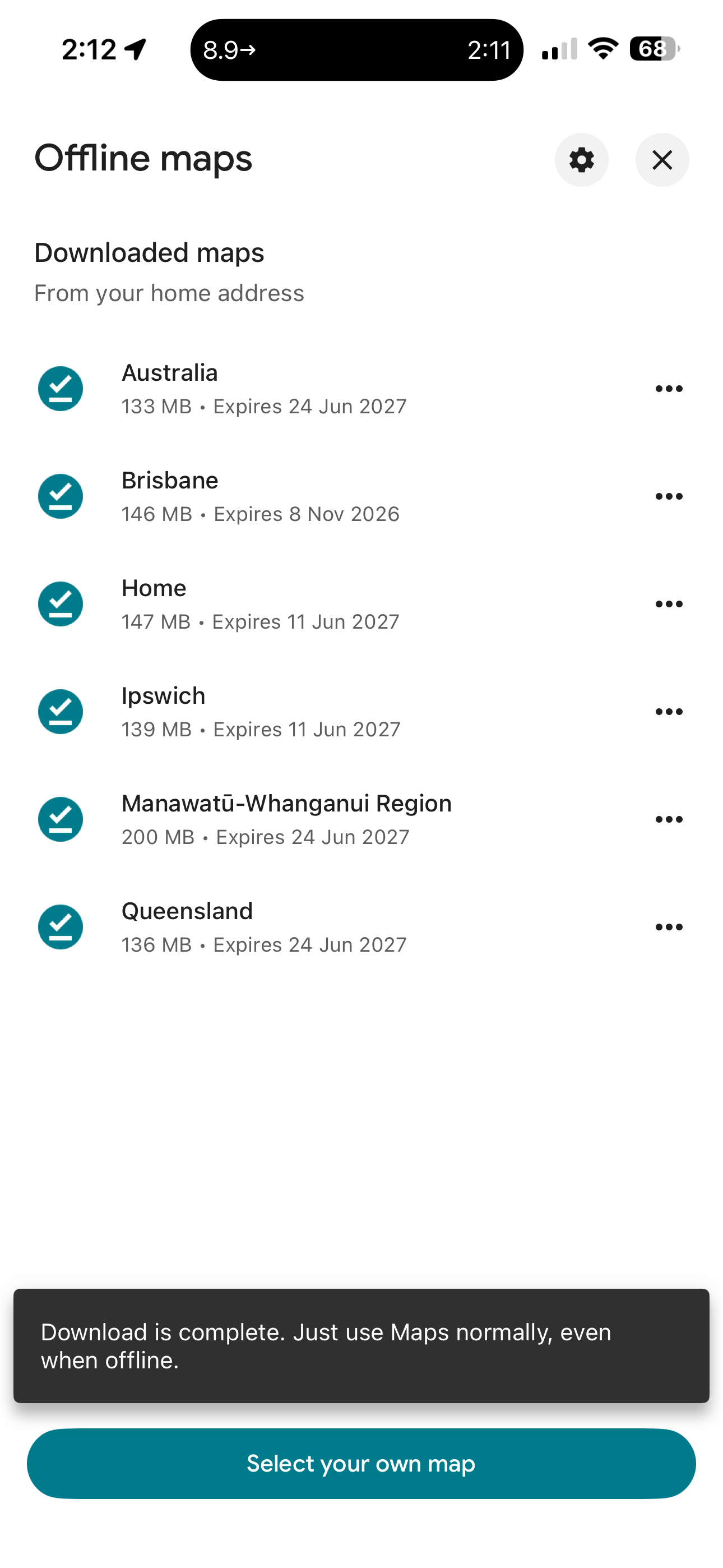
Using “Offline Maps” with either Apple Maps or Google Maps is an option instead of using live maps. Offline still uses the same GPS, Bluetooth, and WiFi data to track travel. We found it very useful in NZ when outside mobile coverage areas. It does require that the maps are updated on a more frequent basis that the inbuilt maps in a car system.
My wife only uses her phone data for navigation all the time (even on familiar routes!), having the car’s connectivity turned off, and hasn’t run out of data yet in over 15000km of driving in 6 months. She’s not on an expensive plan with vast amounts of data, although she may well be running into throttling, I think it slows the speed to 1.5Mbps, which isn’t much less than we normally get at home anyway. The car’s touch screen still works normally, no need to touch the phone as maps comes up as soon as it is plugged in.
For Android users, some helpful information about using Google Maps offline (for example, that you have to download one area at a time – so you must plan ahead to cover the areas you’ll be visiting), and about the OsmAnd Maps app, which works offline by design.
The advanced option: OsmAnd Maps
If you want a much more powerful way to navigate without a signal, you should look into OsmAnd Maps. Unlike Google’s solution, which treats offline maps as a minor side feature, OsmAnd is built from the ground up to be used without cell service. It uses OpenStreetMap data to provide detailed maps that include everything from hiking trails to obscure rural roads that Google sometimes misses.
The best part is OsmAnd can be used for navigation on Android Auto just like Google Maps. However, unlike Google Maps, you can download large regions of the map all in one go. You could download the entire United States with one tap if you really wanted to (and have 15GB of phone storage to spare). More realistically, OsmAnd allows you to download individual states and provinces.
One hopes OsmAnd Maps has detailed maps for all parts of Australia as well.  I haven’t used it myself.
I have downloaded Australia as a whole map plus Qld and parts of NZ at one time using Google Maps. I guess that for finer detail each area may need individual downloads, that part I haven’t checked.
Re convenience and the ‘so on’ a lot of drivers are not interested in downloading maps, checking for new releases or having them pushed and will be happy to pay a reasonable amount for manufacturer’s online services - or will use whatever data they need and buy a plan accordingly.
The issue for me is the principle of charging for something I have already paid for. Functionality. I don’t care about map updates etc and can easily pair the phone to the system wirelessly, which I do. So it’s not about the functions per se, but the cheek to try and make me pay for something I already had. $29 per month or $229 per year to be precise. What next?…paying to use my heater? Radio? Cars have gone too far with this connectivity back to the manufacturer - at least it’s not Chinese as I think that’s a risk when cars have microphones and can also be remotely disabled. Not a conspiracy theorist but common sense can see risk in some situations and technologies.
As outlined above:
Until this is done, it isn’t known if you have already paid for, in effect, a lifetime subscription to Audi Connect services or whether there was a complimentary period (e.g. 3 years) included with the car on its purchase.
If it was complimentary for 3 years, in effect you have only paid for 3 years worth of subscription on purchase of the vehicle. Information suggests Audi Connect has been a subscription service since its inception in 2019, with 3 years of complimentary subscription after a new vehicle is purchased:
It is possible (but unlikely unless it was a special arrangement) that the information, marketing materials or agreements on purchase indicate Audi Connect services wasn’t a subscription service when you bought the vehicle and Audi changed this after purchase, then you may have grounds to argue you should not be paying for a subscription into the future.
They could, if there is an upgraded option above a basic level. Say climate control air-conditioning where standard air-conditioning isn’t climate control. And radios with additional features such as being able to stream music rather than relying on free to air broadcasts.
Anything is possible… and why it is important to understand what one has paid for… and the cost for ‘upgrades’.
Fully agree. And while there are privacy concerns, a manufacturer could use the collected information to decline a warranty claim (saying vehicle has been misued for example) or sold onto insurers to allow insurers to ‘customise’ insurance policies. Such us concerning and cars will become ‘Apple devices’ where one questions who actually owns the car.
It’s not only Chinese-made connected vehicles – and not just vehicles – that can be doing this.
Any connected vehicle has the capacity to record everything that’s happening inside and around it, as well as being in principle remotely controllable.
Any vehicle manufacturer could be providing a spyware service to its originating country’s government.
Not to mention ‘malicious actors’ adding their own spyware apps, as they do to other computing devices such as PCs and phones.
Phones are already an excellent platform for spyware, with a much wider reach than vehicles. Many people who deal with sensitive information still carry their phones everywhere and never think about the fact that the phone can be watching and listening and recording everything that happens around it.
A couple of examples involving phones:
Pegasus software is harder to detect than many other smartphone exploits, capable of reading anything on a device that a user can, and can access sensitive information such as locations, photos, and live camera and microphone recordings.
They’ve known about this for how long?!
Failure to prevent the exposure of sensitive location data of military assets could be forgivable if it were a new problem, but according to Wyden’s letter, it’s not: The Pentagon likely knew about the issue for a decade.
According to the letter, government contractors briefed military leadership about the ease of tracking smartphones owned by military members way back in 2016.
“DoD officials have not treated this counterintelligence and force protection threat as a five-alarm fire,” the letter asserts, adding that the Pentagon “has known about this threat for over a decade, yet have failed to take meaningful steps to protect our men and women in uniform.”
We bought a Mazda 6 in 2018 and we received an email in 2019 saying that a map update was available. When we enquired, we were told there would be a charge for the update. We queried this as we had not been told there would be a charge for updates. (The glossy brochures just talked about annual updates being available.) We were referred to the sales agreement where in the small print it did mention the cost. Eventually, one more year’s update was installed for free. That version is still running in the car’s navigation.
Unfortunately the vehicle doesn’t have CarPlay etc, so we have had to use our phones’ navigation since then to have up to date navigation.
