My car is now 9 years old and still running happily on the original 12v car battery.
When it was brand new I installed Inox battery conditioner into the battery cells. The battery has unscrewable caps on each of the 6 cells so that water/inox etc can be added.
Inox battery conditioner is alleged to extend the life of lead/acid batteries by preventing sulphation of the cells.
Whether or not the inox does what it claims I have no way of being sure, but I am sure that 9 years and still going is an exceptional life for a car battery.
I am now looking around at new batteries as sooner or later my 9 years old battery will croak. But it seems that car batteries with unscrewable caps on the cells are a thing of the past. They are now all sealed so that I cannot install inox conditioner.
Whether this is a conspiracy by battery manufacturers to prevent people using inox, I do not know, but does anybody know where batteries with screw caps on the cells can still be bought from?
One doesn’t need battery conditioners for long lasting batteries, possibly battery quality is a large factor, as well as how hard the battery used. I posted our own experiences here:
There are reports that many newer cars are significantly heavier on their batteries, causing shorter lives. Some report a couple of years compared to a decade.
My car has a “feature” which stops the engine running when you have your foot on the brake and the car is stationary (at traffic lights for example). When you take your foot off the brake, the engine auto restarts. This is supposed to be a fuel saver feature.
Well, it does save fuel, a very small and insignificant amount, but it also means MUCH heavier use of the battery, multiple restarts in even a short journey. It’s also a #$%# irritating nuisance. Luckily the feature has an override button.
This may explain heavier battery use in modern vehicles.
I will check about flip offable covers on new batteries.
Thanks.
I have tried unsuccessfully to flip those covers off a couple of batteries in friends cars, to instal inox conditioner.
Perhaps some are easier to flip off than others…
Known as stop-start. Note you require an EFB or AGM type battery. Always tell the sales person you need the battery for a stop-start car. If your car uses EFB you can use either, but if it uses an AGM it requires an AGM for proper charging.
Some buy regular batteries and report a few years of life in stop-start cars, but always best to buy the ‘right one’. Unfortunately they are more expensive than conventional batteries, often $100s more.
The charging systems in stop-start cars are more sophisticated than in ‘regular’ cars so whether it has been that, your always disabling the start-stop feature, or inox contributing to longevity may or may not be fact re crediting inox.
Some may have a bonded cover. On everyday Century branded batteries I’ve previously been able to flip the lid. Requires some effort, a large HD screw driver and safety measures to ensue the battery cannot be shorted while attempting. The cover is likely to bear witness of the force required. The cell caps have been replaced by screwed plugs.
I’ve various experiences with how long low maintenance batteries can last. The value of an additive, EG Cadmium sulphate is uncertain.
It appears as for many types of additive products opinions shared on line differ. The previously mentioned product and the INOX brand is owned by an “aspirational” Queensland based business Candan Industries Ltd.
OK thank you.
In order to arm myself with a bit of background knowledge so that I am not easy picking for a smooth talking battery salesman/woman, can you elaborate on what EFB or AGM means? I am qualified in Electronics Engineering.
As for the inox, whether it works or not I don’t know but at about $15 cost for a new battery, it’s worth the risk that it might extend the life of the battery.
And while Pb (Lead) based batteries are not good if disposed of improperly, added Cd (Cadmium) is certainly a greater environmental and handling risk. Even if disposed of correctly the Cd content added with a buffer would multiply the risk substantially of any spills and safe disposals of liquid contents. So if anyone is disposing of a battery containing Cd, be sure to ensure it is taken to a proper disposal service and also ensure the staff are aware of the added Cd.
AGM Battery is an Adsorbed Glass Mat Battery, the liquid has all been adsorbed into the glass mat so there is no free flowing liquid in the battery. Adding extra liquid will not benefit the battery, in fact it can decrease the performance and safety of the battery. This is probably the most advanced technology standard battery in terms of usage and longevity.
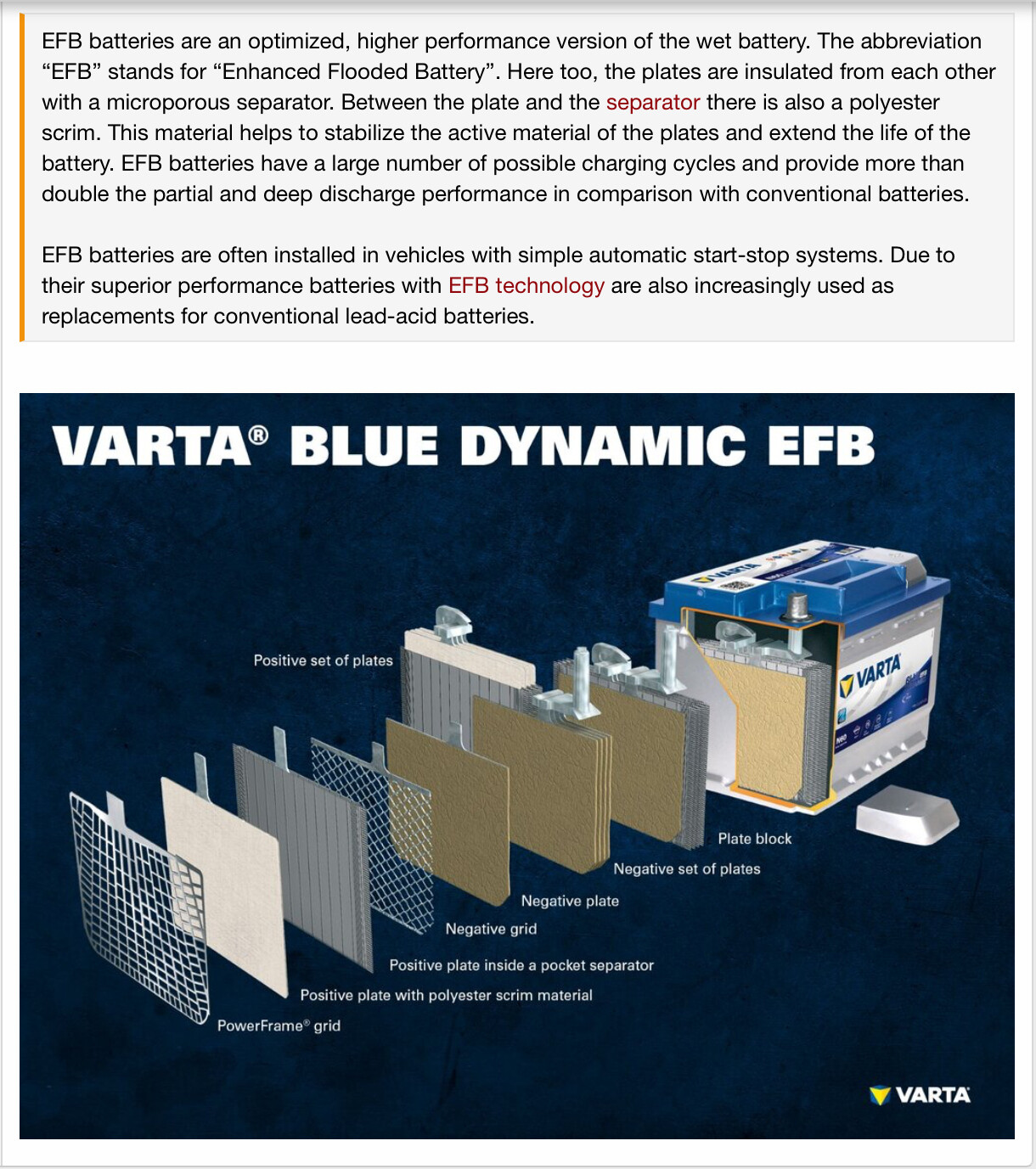
EFB is an Enhanced Flooded Battery, also known as Advanced Flooded Battery (AFB) or an Improved Wet-Flooded Battery (IFB). It is a free flowing liquid battery that sits in terms of usage and longevity between a standard Lead Acid Battery and a AGM one.
EFB are generally cheaper than an AGM. It can be mistaken for a standard or a AGM battery, but is not quite either of them. Again, adding liquid to a EFB is not advised as it will likely interfere with the battery chemistry.
Both a EFB and a AGM battery will have much better life spans in stop-start vehicles than fitting any standard battery.
Thank you.
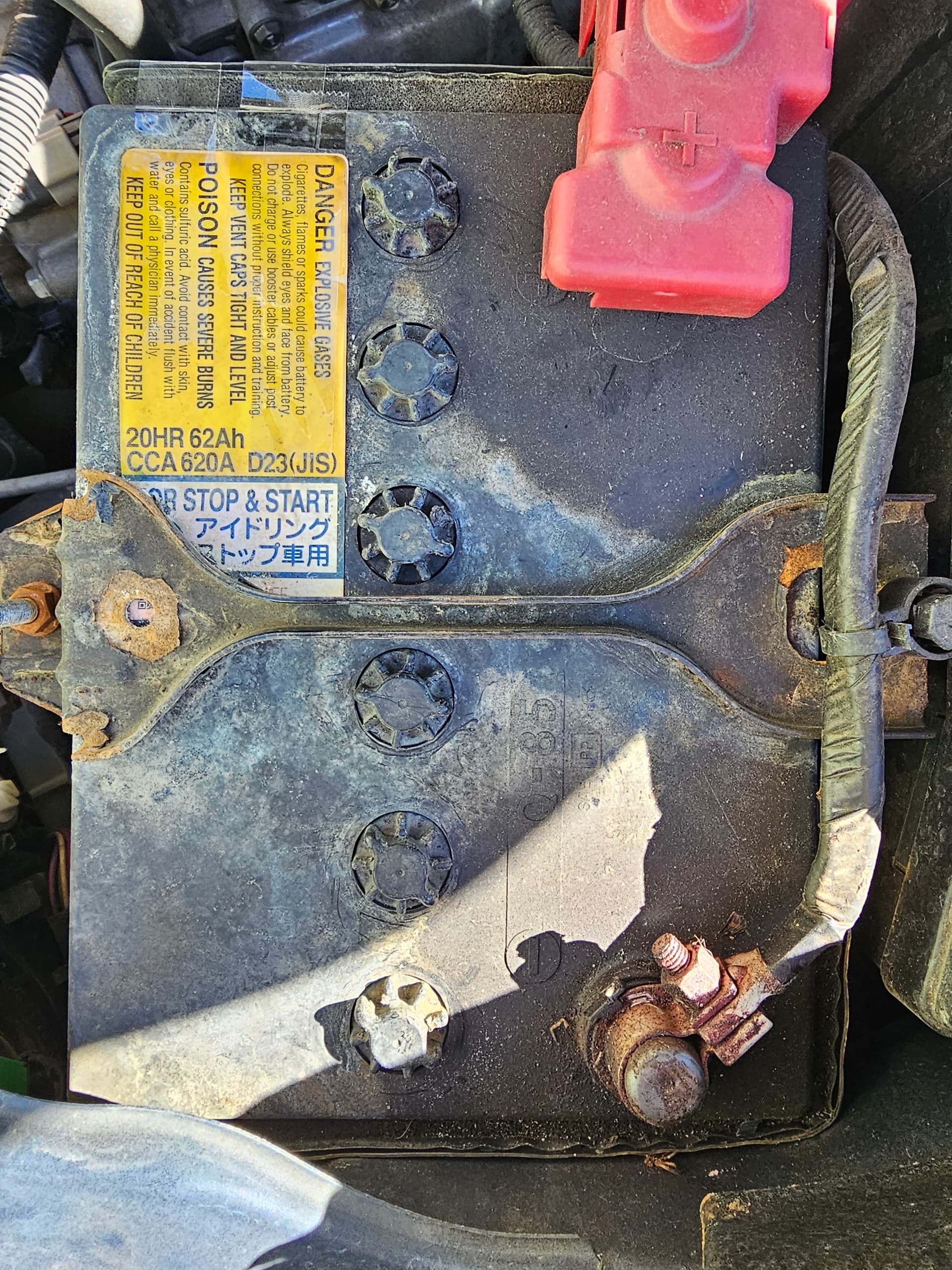
I can see the plates and free flowing electrolyte inside my car battery so it’s not an AGM battery.
The label on my battery is attached hereon.
It’s a stop start battery…
The girl in the local auto parts shop told me I needed a special battery for my car, costing about $350!!! and when I explained to her that I always disable the stop / start feature, and could I thus get away with a cheaper battery, my words were lost on her.
At this stage what I can see written and partially covered is “For stop and Start”
When I get a spare “get my hands dirty with battery residue” moment I will undo the battery holder and check out whats written underneath and use google translate if need be.
But the important matter for me is, can I install a normal car battery which has similar CCA rating and probably costs alot less than special stop start battery? Note that I DO NOT use the stop start feature at all (I loathe it) so the main issue might be the special charging routine/circuitry that might be involved for this car.
Thanks
BB
I’m not any trained mechanic. It would be best to ask your mechanic or a person who specialises in dealing with the type of vehicle you own. If you have turned off the feature, my untrained and therefore unreliable opinion would be that the normal battery would work. It may not last as long as an EFB or a AGM battery and so may in the long run still not be a saving even if purchased at a good discount.
EFBs are designed for many more cycles than any normal standard battery, many more being that a standard battery on average has an expected life of 30,000 start cycles, EFBs have an on average expected life of 85,000 start cycles. So EFB have more than double and nearly three times the expected life of a standard battery.
Another point about EFBs is that they come with improved thermal stability over standard batteries, which means they are much better suited to hot climates such as can be expected in Australia. They also hold charges better, they can be deep cycled about twice as many times as a standard battery, they charge better (more effectively and efficiently) and these are just some of the reasons they can be a better choice and also why they are more expensive.
A further thought about using a standard battery as opposed to a EFB, is that a stop-start vehicle is designed with the idea that while stopped and engine not running, that all the electronics of the vehicle are still being supplied sufficient energy for the needs. While stopped though the emissions of the vehicle and thus fuel usage would be reduced in comparison to a non stop-start vehicle. Depending on where you are driving and the possible number of stops and starts this ability to reduce fuel usage may be a further saving, while still providing the vehicle with all its energy needs if a EFB is used.
While I understand you loathe the idea of stop-start and so turn it off, you may be causing yourself further hip pocket pain. Turning the feature off could also be putting the vehicle outside the ADR specifications for your vehicle. This could affect insurance coverage as the vehicle is possibly not being operated as designed. If your insurers decide that you have deliberately driven the vehicle in a way it was not designed to be usually run, they could deny or reduce coverage in the case of an accident.
Thank you.
I will do a price comparison and let that assist my judgement.
The stop start feature may save a small amount of fuel and emissions, but personally i find it a nuisance as it introduces a delay between taking your foot off the brake and when you can get moving again. Maybe only 2 seconds but irritates me.
Also the air conditioning stops while the engine is stopped.
If as you suggest the stop start battery may give a significantly longer life, it may be worth the extra cost. As it is, the current battery is 9 years old which in my experience is pretty good innings for a car battery.
Thanks.
Ill do another price check at Repco, SCA and Red Point on brand name only batteries as I dont trust Repco or SCA branded parts.
Anecdotally some vehicles supplied with EFB batteries may have advanced battery condition monitoring to ensure the expensive battery is not discharged below a reliable state of discharge.
Obviously John Cadogan doesn’t give a tinkers for the stop start feature.
My Sooby has this insidious “feature” and when I purchased it, the salesman did pitch it to me as a fuel saver. But thankfully he also showed me the override/defeat button to turn if off if I didn’t like it - (which I very quickly during the test drive decided I didn’t). So I didn’t have to wade thru the owners handbook to discover that the stop/start feature can be over ridden.
I do have to remember to press the disable button every time I start the engine, which is not a big deal, except now and then I forget and that leads to annoying things not just at traffic lights. So a permanent disable button might be a good idea.
I can set the digital display to show me how much fuel has been saved by the stop start feature on any given trip, but as Mr Cadogan says, it ain’t very much.
My understanding is that the system is more about emission reductions than fuel saving. It is a very clever system with a range of components and sensors involved. If the battery deteriorates, the system will become inoperative until the battery is replaced with the correct one. My battery was 7 years old when replaced.
DC
My car is over 10 years old and still on its original battery and i’ve never added anything to it. They must have been making some good quality batteries around a decade ago.