Is it yet another ‘improvement’ that just ends up costing most people more money?
My wife noticed ads for Members Own health insurance.
She thought that they were a health insurer and wanted to check out their policies so I looked at their website
I had to provide an email address and a phone number as well as my name to proceed and details of 3 obscure health funds which I had never heard of were then displayed
All 3 were around $100 a month less than our Bupa Top Hospital Cover With Co-payment And Classic Extras but 2 were for Bronze and 1 was for Basic.
The co-payments were $500 and $600 per visit.
We pay $50 a day for hospital up to a maximum of $250 a visit.
I have at least 1 day surgery procedure a year so all I pay is $50 a visit instead of $500 to $600. The total cost for the specialist, anaesthetist and the day surgery ranges from arounf $3,000 to $4,500 per visit and I pay no out-of- pocket costs.
My wife has been advised that she will need to have both knees replaced shortly so the last thing we need is some shonky policy which leaves us totally ripped off.
Far better the devil you know that charlatans you don’t.

1 Like
… so long as you know which is which. I’ve been with a ‘members own’ for years and never had a problem. I’ve checked a number of the commercial (not not-for-profit) including BUPA over the years, and recently, I won’t be changing any time soon …
2 Likes
Some more advice on health insurance choices for those looking for the cheapest alternative:
2 Likes
I have just been advised that my policy. (which has been in place for 12 years) is going to be increased by 8.6%. The average according to all sources is 3.62% Bupa has failed to explain the reason. I think i;m am being targeted by having a policy that is now obsolete.
What to do?? For me its; a $22 a month rise.
Pay the years premium? I am only differing the rise, how can they impose this cost way, over the average?.
Welcome to the .community @imax3
Bupa is a business that is not required to justify its increases to anyone excepting government. Their increases are part of the computations of the ‘average increase of 3.62%’ you reference.
As you surmise when a fund has an obsolete policy they can use premium costs as a tool to lose customers in those obsolete policies and hence wind them down. Sometimes the newer policy is more favourable than the obsolete one so might be worth looking into if you are otherwise happy with Bupa.
The answer to your question in a practical sense, your options are to wear the increase, or change to another Bupa policy or change funds. When one changes funds the new fund will usually waive all waiting periods previously served with the prior fund so the member is not disadvantaged by the change.
You might try the Choice private health comparison tool, free if you are a Choice member, at a cost if you are not. There is also a government comparison tool. They each point one at the funds most likely to suit based on the criteria you provide.
Over the years I found my small fund, HCI, sometimes has one of the largest percentage increases, but was still one of the most appropriate and cost effective funds for my needs*, so it is not just about the amount of the increase; keep the focus on the overall benefits, [extras] benefits you actually use, and costs, not just the increase.
* edit: After yet another above average increase from HCI I checked via the Choice tool and HCI was again in the top 2 listed non-restricted funds suiting my criteria, and easily won by having significantly better benefits (that I use) than the other that was $4 pcm cheaper.
2 Likes
Simple do not use Bupa silver plus hospital cover did not cover any of my wife’s operation despite being in a hospital excess paid and not a service or type of operation etc. that is disclosed in the policy as ‘not covered’. P
Welcome to the Community @sucker
Could you provide more information? Normally the only things covered are those explicitly shown as being covered although some funds do ‘footnote’ certain exclusions.
As you unfortunately learned it is always advised to confirm cover or lack thereof prior to a procedure, rather than possibly getting an unexpected surprise afterwards.
Since this is specific to Bupa I am merging it into the Bupa topic, although another appropriate one may be
https://choice.community/t/bupa-and-hbf-cut-health-insurance-benefits/15205/11
as well as the network providers that need to be used.
1 Like
Fundamentally be careful what you think 'hospital cover is. Bupa silver + does not cover any doctor/ surgeon operating charges while in hospital. All ‘out of pocket’ expenses https://www.bupa.com.au/health-insurance/out-of-pocket-tool
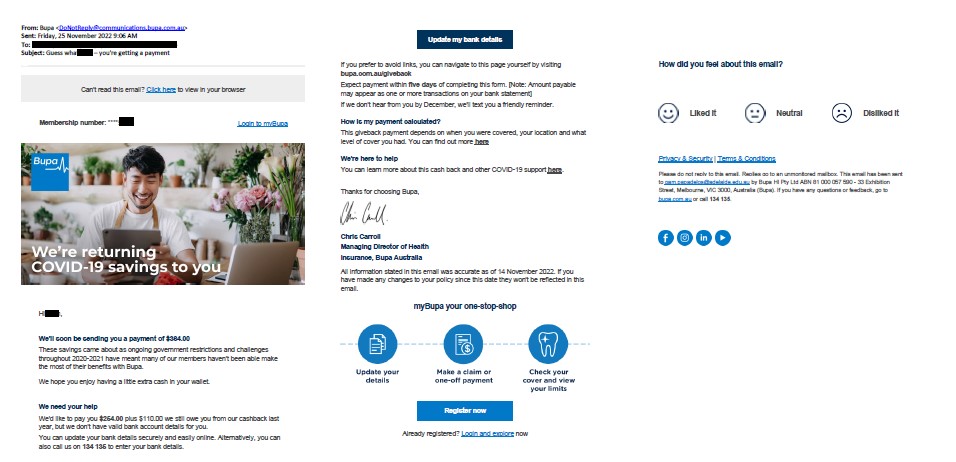
We were somewhat dubious when we received an e-mail from health provider BUPA with a promise to We’ll soon be sending you a payment of $364.00
the e-mail looks authentic and asks as do so many spam e-mails to upload your bank details. Hovering over the links in the e-mail the urls do not contain any recognisable links to a BUPA site, and it looked like a well thought out scam.
Also BUPA on its Security and fraud protection webpage
states:
Please be aware that Bupa will never:
- ask you to provide information such as your account details, password, banking information or myBupa login details on an unsolicited basis or unsecure channel such as email.
Whilst this does actually appear to be genuine, given these days of hacked health accounts and scams, I am not sure this is the best way to go about doing this in the current climate of distrust.
4 Likes
Welcome @tony.flaherty to the community.
You have come to the conclusion that as Bupa says they will not ask for any bank account details over email, then what you have received is a scam email.
Bupa were refunding money to members, but I suggest you give them a call about this, and do not respond in any way to the scam email.
In the email you received, the link to update bank details is very different to the secure link specified in the linked item from Bupa. Come on, seriously, bupa.oom?
5 Likes
Hi @tony.flaherty.
I’ve also received a ‘We’re returning Covid-19 claims savings back to you’ email from my private health insurer (not Bupa) but they’re going to do that:
‘Via a contribution on your policy…which covers your normal payment for…no need for you to do anything’
I would certainly call them before emailing any details 
6 Likes
It likely is a genuine attempt to communicate with you the member. One can never be too sure! Contact BUPA using the phone number listed on your membership card or annual statement.
BUPA is not alone in sending emails to its customers full of imbedded links to better serve us the customer. Over many years of doing so they’ve created an environment in which many of us have become accustomed to tapping on emailed links to transact business. These days it requires more than average ability to determine what is assured of being genuine.
Here’s a portion of what I received.

Two details in the remainder of the email suggest it may be genuine. They include the last 4 digits of my member number and last 4 digits of the bank account I previously linked to receive refunds. This suggested a genuine email, assuming it had not been tampered with. As I had no need to respond I simply checked the bank account and noticed a deposit several days on.
A very concerning observation on the reliance BUPA place on the integrity of email and users clicking it tapping on links. Hopefully always to a safe place.
“I quickly counted 12 different opportunities within the email to click on links supposedly all provided by BUPA to help serve us better.”
4 Likes
I have had a quick look at the website, and it is silent in relation to the information you received in the email.
Try logging into your BUPA account and see if there are any messages/links indicating that they are reimbursing members.
If the account area also doesn’t contain any information, I would not be clicking on any links in the email or providing any personal information until such time its authenticity is substantiated with BUPA.
See if you can send a PM through your account login (I am not a BUPA member so don’t know if it is possible) or contact them using one of these methods:
It does seem strange to ask for bank details as if one has a direct debit payment with them, they already have your banking details. If one’s payment is by credit card, they should be able to refund the amount to the card. I can see that if you manually BPay or EFT each time a premium is due, they might not have the means to issue the refund.
4 Likes
On the first searching the BUPA website for “giveback” will provide the following. It took more than a quick look to work that one out.
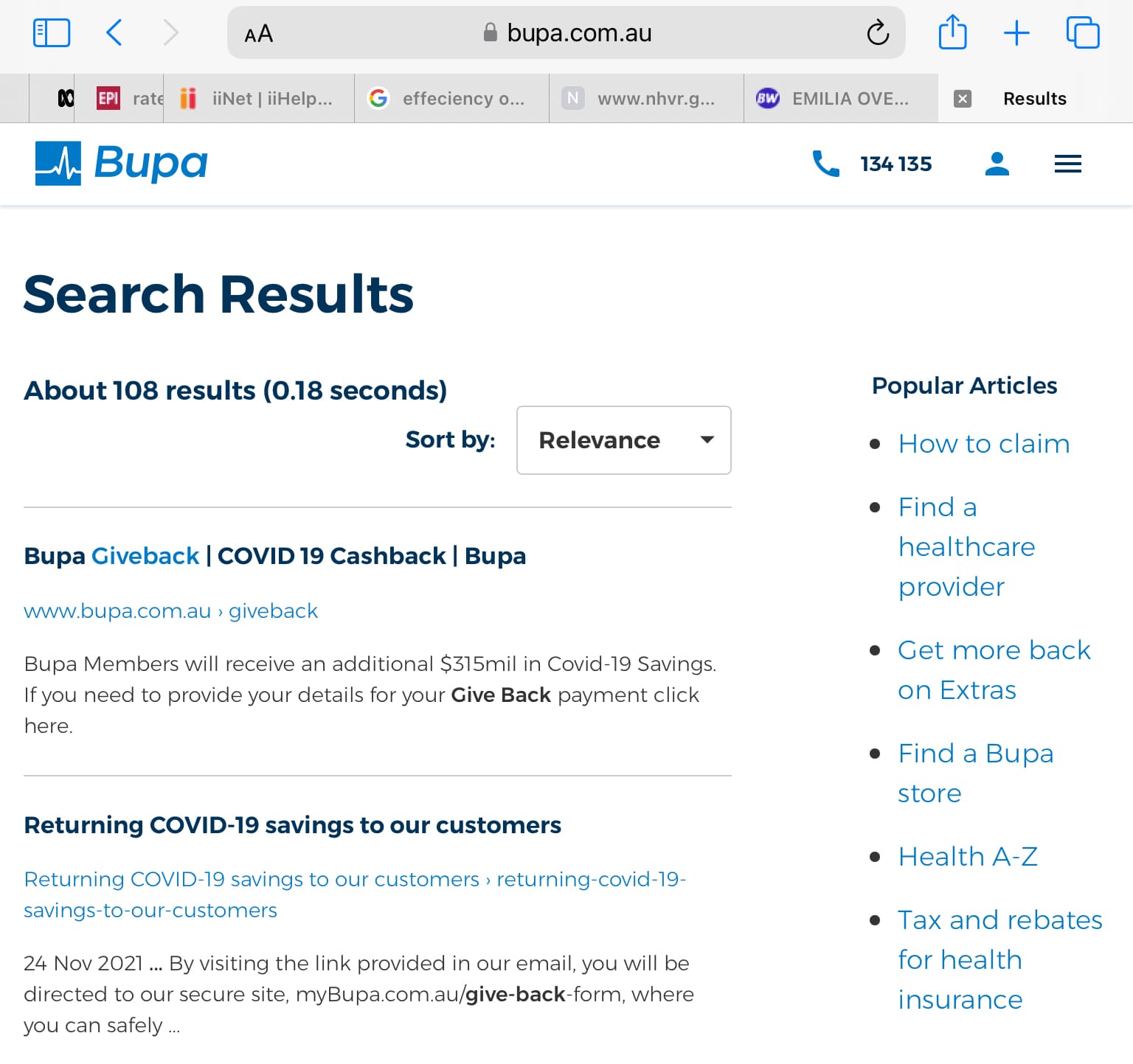
On the second, being a BUPA member I can confirm that logging into one’s account or using your MyBUPA App will also find similar content. It’s as secure a method as any online these days. IE only as secure as the latest software updates and devices can be at the consumer end. Unfortunately security at the other end (multiple businesses) remains open to ongoing failures.
3 Likes
I think that the method used by my private health insurance, which is providing a credit instead of a refund for the Covid19 savings, would be the safest as far as online risks are concerned? It also prevents anxiety that the email asking for bank details is a scam?
4 Likes
Just received an email from my health fund, HCF, about my cashback.
Pleasing to see no links to click on about updating bank details.
3 Likes
I know some health funds are returning money to members - I have received a relatively small amount from mine and so has my partner.
However, your health fund probably already has your bank account details for the payment of refunds - why would they ask again?
We too received one from HCF and because they have our bank details they didn’t need to ask for anything. I noticed the amount in our account today.
