Interesting article, but Snowy Hydro and Splityard Creek Dam have always pumped when there is excess generation on the grid…and subsequent electricity pool prices are low. As there is excess wind and solar generation causing excess on the grid when traditional generators are also generating, it follows past model of using excess to pump.
Also, the electrons moving backwards and forwards on the networks don’t care how they are generated, so some of those used by Snowy Hydro will have originated from non-renewable sources.
The AEMO might hold the answer in it’s archived records. It’s Snowy Hydro’s option to choose who it pays for what it takes out. Only the price is set by the market.
Note: Science content.
I doubt we should get too caught up in what the electrons are doing at any one time. They are forever trapped in circuits and simply passed around without any real identity or ownership.
Electrons do not move very fast. The drift speed of electrons in a copper conductor is measured in millimetres or fractions of millimetres per second. (IE an electron might move only one metre or so every hour)
As there are transformers at various points in a system electrons don’t move from the generating station into the home. The electron flow is decoupled at each transformer and the energy transferred through the coupling of magnetic fields.
There’s an analogy that uses water flowing into a big bucket from a number of different sources and mixing. And water flowing out through a number of points. It visualises one aspect of how a simplified generating network functions. It’s not an accurate model of the electrical properties of conductors, transformers etc.
If the price is low but positive how is that even a benefit?
If you mean that the farm has local energy storage and when prices are low or negative, the generation is switched from supplying the grid to going into local storage then OK - although that raises the question over what happens if the storage is full.
Nicely said @mark_m. We also tend to consider current flowing from positive to negative, or positive to earth, or ground. In semiconductors it is “holes” flowing. Not very useful to consider electrons flowing anywhere except in cathode ray tubes. Anyone remember them?
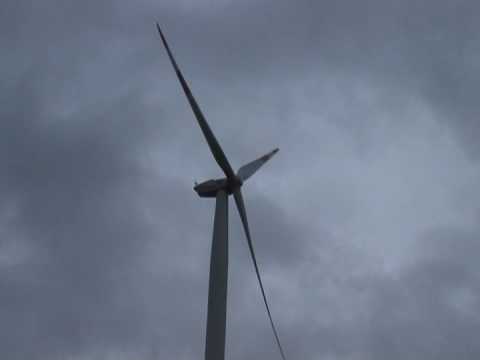
They turn their blades such that they don’t catch the wind and rotate. Same is done in high wind events to protect the generation unit that sits behind the central axis of the blades. This video shows blades turning off wind before a storm…
Doesn’t turn off the power generation @gordon, just stops the current going anywhere. What possible use would that be, unless you were doing maintenance on the system and didn’t want current flowing to possibly zap you?
I take it from previous postings that you know power = voltage X current?
Zero current X Voc = zero power. IE there is no power generation when the panels are open circuited.
No @gordon, since the potential energy generated from solar to electricity in the panels cannot be released, that which cannot be stored will be released in another form, heat. You can use that potential energy for some useful purpose, or just waste it. Up to you. No doubt commercial solar power producers do not waste whatever potential energy they produce by simply “turning off the switches”.
Nasty contracts.
“Tailem Bend has an off-take agreement with Snowy Hydro that broadly requires it to switch off when wholesale electricity prices go into negative territory, although the details are likely to be more complex than that.”
In other words, new generating guys have to shut down, so the existing players can get the price up through less competition when demand is low.
The other main issue is voltage regulation and flows…overgeneration can cause voltage increases causing other undesirable impacts to the network. Changing network design flows is unwanted as networks are designed to flow in a particular direction. Both could result in network protection being triggered, shutting down parts of the main grid.
Negative prices aren’t the reason for network operator intervention. Their intervention is to protect the network and its users.
Requests to cease generation come from AEMO which oversees the operation of the main eastern grid (Tas, Vic, SA, NSW and Qld) to ensure its relability/security.
See the National Energy Rules for further details.