Thanks for all input here everyone. Here’s the results of our investigation, up to 40% in savings on offer!
5 Likes
Hi Brendan,
I am glad that you ended that sentence with an exclamation mark, rather than a full stop.
It would be almost impossible to save 40% simply by spreading your shopping across multiple supermarkets.
A proportion of what most people spend is on items that don’t have a significant price difference between the various supermarkets. Even if this only covered say $50 of a regular $200 shop, you we need to buy the other items for $70 (an average discount of 53%) to get an overall saving of 40%.
Specials, with a discount of around 50%, are generally spread across two or three chains in a given week. Savings from items on special at at your first supermarket would be achieved even if you didn’t multi-shop. Adding to this, the half price specials at other shops are likely to be matched at your regular shop a week or two later.
My view is that multi-supermarket shopping might save around 10%, possibly a bit more for some people. Some of the savings can be chewed up by travel costs and/or spending extra on things you would not have bought if you didn’t go to the additional shop(s).
1 Like
We comparison check most everything that goes into our trolley in real time using the Coleworth apps, so probably atypical of most shoppers but on occasion we hit about 40% because of specific high value specials ‘when the planets align with our needs’. Is that reflective of our every week shop? Not at all.
On a typical week a range of 10-15% would be our more routine comparative savings.
Scepticism is good but dismissing reports one might not agree with? Not so much. Also, our Coles and Woolies are about 50m apart making it reasonable to buy from both.
2 Likes
Maybe it is a question of journalistic puffery. Getting reports saying many will save 10-20 % and that some might in some situations save up to 40 %, which number will be in the headline?
The actual saving will vary enormously depending on the location, how close the competitors are to each other and to you and how much trouble you are prepared to go to. If saying it is reported that it could be 40% leads some readers to save 15% and be better off, why not?
If anybody wants to shoot the moribund horse of 40% instead of looking at the substance of what the article is saying - well the forum serves many purposes.
2 Likes
Is this saving coming from both shops or just one? If from both, the savings from going to the second store might be around half of the total. Also, if you are stockpiling specials those savings relate to a longer period of time rather than just the one week.
Questioning one line in a report and dismissing the report are two vastly different things.
That would be the aggregate, which is how the question was posed. eg Saving money on the weekly shop, not saving money at each store individually.
That depends how one shops. If one is always stockpiling the deal of the week and there is a relevant deal of the week it evens out. That would be less so when (as is common) Woolies has the same sale on even weeks and Coles on the odd weeks.
Lets say there is a use-by ‘tonight’ dated package of meat marked down from $30 to $20. Buying it and putting it in the freezer for next week or a few weeks after is not exactly stockpiling. OTOH if one still has TP from the COVID shortage periods and has not had to buy any since, that is stockpiling 
Understanding any data point eyes wide open is good and your questions add focus, but in the end even if an ambit number is headlined and it causes more people to comparison shop and it saves them money →
1 Like
It was said in the report.
- CHOICE Community members who practise multi-store shopping tell us they can save 20% to 40% off their weekly groceries
Is there any reason to doubt that’s what Community members believe they achieve? It’s not necessarily every respondent, or every weekly shop. 20% might be common. 40% might be less common.
We don’t have the full Coles vs Woolies choice.
From our own experience we have some weekly shops where we stock up on some of the higher cost products we use all the time. Tea is one. Dish washer tablets, laundry powder, etc are also regularly heavily discounted. I typically check the prices on selected items, and will purchase if on special when not on the list to stock ahead. Occasionally we find the planets are in alignment and most are discounted. They are all items that will keep.
For more perishable items such as F&V, seafood etc it’s usually possible to make better decisions. Prepackaged F&V is typically premium priced, while looking for the specials in the seafood display rather than a certain product offers a saving. Some of us might see these simple choices as savings, while others will say that’s not a real saving, because they only buy loose or to a budget for seafood etc.
I found the Choice article value as it highlights the benefits of tactical shopping, and some of the strategies that can help to make the budget go further. Our good fortune is we can stretch to buy extra of our staples when they are discounted, and are prepared to defer or make alternate selections when items on the list are too expensive.
There is more than one way to look at savings.
4 Likes
It is a good strategy. Shop the specials.
Now I get a heads-up via email when specials are coming up from my normal supermarket.
It knows what I regularly buy.
Ok, don’t need my normal brand of coffee right now, but will in a few weeks. So buy it now on special at 50% off, and when it is not on special and normal price again, I won’t need to buy it.
1 Like
The heading for this topic is Multi-supermarket - good for saving"
The opening paragraphs in post one are:
The heading for the September 5 2023 article reads “Why sticking to one supermarket is costing you money”
All of the above point to the issue of whether it is cheaper to spread your shopping over different supermarkets and, if so, how much do you saved compared to buying everything at the one supermarket. If the question was "If you shop at multiple supermarkets, look at total the savings amount listed at the bottom the the receipt, what are your total savings? your approach might be valid.
As an example, if nearly everything you buy is on special at Coles and/or Woolworths. You spend $150 in each shop and the receipts tell you that you have saved a cumulative $200, making a theoretical saving of 40%.
However is you bought all the items at the one supermarket, the total cosy may have been $375. This means that by spreading your shop, you have saved $75 or 20%.
Noting that the above is an exaggerated example and that level of saving would not occur very often.
My above comment is in line with your view, that the saving might be possible but probably not achievable very often or by the masses. The reason for my initial post was to bring awareness to the fact that information provided by Choice and the supermarkets might lead people to believe that they can save more than what is likely possible.
The is nothing wrong with providing information to help people save money. If the number is not relevant to the overwhelming majority, why stop at 40%? Figures of 60% and 90% might be possible and would only be marginally less relevant.
Well that idea has been explored very thoroughly indeed.
1 Like
It is always interesting, from the ACCC to Choice to others the message is ‘shop around’ for the best deals. I wonder how many people have yet to get the message and in our world of duopolies whether it sends much of a message to corporate Australia as consumers go back and forth between them.
1 Like
Hi folks, we are still working on more investigations on this issue. Please keep sharing your experiences, and if you’re interested there may be opportunities to talk to media about too.
Am late getting to this but to accurately assess value for money, it is important to check and compare unit prices not only within a store but also between stores. This is because the pack sizes of national branded products can differ between stores as also can the store’s own brands.
So, comparing only selling prices is not always a good guide to value for money.
Using Corn Flakes as an example:
- Woolworths sells Kelloggs Corn Flakes in 890g, 450g and 220g packs and Coles sells them in 750g and 380g packs.
- And comparing the supermarket own brands, Woolworths does not sell any, the Coles pack is 440g and the Aldi pack is 700g.
- The selling prices and unit prices also vary greatly between the supermarkets , brands and pack sizes.
5 Likes
Unit pricing can also help you work out that a special might not save you as much as the supermarket would have you believe. Two current half price specials at Woolworths are Sorbent toilet tissues and Handee paper towels.
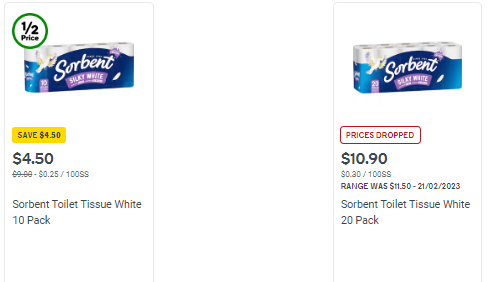
The unit price of the 10 pack is only16.67% less than the 20 pack and still higher than that of alternative brands.
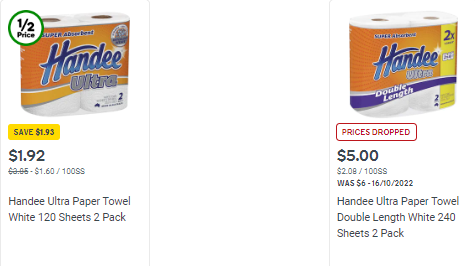
For the paper towels, the unit price of the special is 23.1% lower than another package of the same product and still higher than alternative brands.
1 Like
Usually how the brand is priced. Like similar wood fibre derived sheet products (paper) no two paper products are exactly the same.
Assuming nothing has changed since last year, another reason to question whether there is any return for the premium pricing (even with the discount).
Some of the suggested products and alternatives are store brands, or may not be available in your local supermarket.
1 Like
I recently bought some Coles Ultra paper towel. I use it to clean and dry my cat’s litter trays, because it is economical, and because of its previous very high score from a Choice review.
I have to say, it’s gone from the best, to one of the worst. Clearly, manufacturing has changed, as I noticed the embossed design was different immediately. It is also MUCH thinner, and less absorbent.
So I decided to use some Handee Ultra I had on hand. Wow, that’s worse!!
I would rather pay the extra and use the Tuffy that I use in the kitchen. I use that to wipe out kitty’s food bowl after washing. I can let that piece of paper towel dry out, and use it multiple times before disposal, which more than covers the price differential.
1 Like
Good to see you comparing unit prices!
Not sure if you can access it but you may be interested in this this article about “special” offers was in many newsltd paper and online recently.
https://www.couriermail.com.au/news/national/supermarket-specials-scan-this-before-spending-your-money/news-story/316f03bd439e732e4e289ea42462e4f7
2 Likes
I like buying the Handy Ultra paper towels.They are great quality
Yes we do multi shopping too. 1st stop is Aldi and then if necessary I walk over to Coles nearby and buy what I can not get from Aldi. Ii also use a local butcher, but as we don’t eat much meat so its not for savings but quality & wanting to support a local business that we chose to do this. We have a Costco membership but its quite a drive, so no savings if we shop there…we are members because there are one or two things himself really likes from there such as some coffee and cheeses and we only go there when we are travelling that direction anyway.
2 Likes
