Better not tell Donald about this.
2 Likes
An interesting article regarding what Australia could do in respect to climate change.
2 Likes
Since the Renewable Energy Megathread has been closed, I thought I’d post this milestone (kilometrestone?) here.
I keep an eye on generation in the NEM and saw a short while ago that, for the first time ever I believe, over 50%* of the current power generation on the National Electricity Market (Qld, NSW, ACT, Vic,Tas, SA) is being met by renewable energy.
- includes 2% hydro power, but cant really say if any of that is pumped hydro, pumped up the hill with mostly fossil fuel power.
6 Likes
Solar Energy storage may become easier than Li based batteries. While the research this article looks into is about heat storage at the moment it has implications as a means to store energy to produce power over a long period.
The Researcher’s page where more on the various projects can be be found:
https://www.chalmers.se/en/staff/Pages/kasper-moth-poulsen.aspx#ContentTabBox2
4 Likes
Interesting research, but a bit light on for details as to how much energy can be stored, and why it is better than existing thermal energy collection and storage, which is generally only required for periods of hours to days, rather than decades, as this molecular thermal storage method can potentially achieve.
Now all we need is something to passively absorb sunlight and store it as coolness 
Bring back the now defunct icy-ball I say!
2 Likes
Sure but from what it appears to require at the molecular level not much in the way of scarce metals may be needed. Some of the research papers are quite lengthy so I haven’t got through much on them yet so can’t answer how much it stores or releases. The process might allow efficient storage (if the heat can be stored effectively for years then you would guess it is fairly efficient). If efficient then perhaps the capture could be used to generate power rather than generating heating for building etc. more efficiently than other heat powered generation eg molten salt. Of course it isn’t yet commercial but the article does suggest venture capital are looking to invest.
1 Like
The leap from collecting and storing heat to producing electricity is a significant one, collecting/storing heat doesn’t require scarce metals. Even storing electricity in batteries mostly requires common metals, there is very little Lithium in a Lithium battery (not that it is particularly rare), I understand there’s much more Copper, and perhaps Aluminium, which are plentiful.
I think the “efficient” storage is just in the form of molecular bonds, so heat as such isn’t being stored, and potentially being lost to the environment, as with a hot water tank. Keep the molecules in the desired form, and no energy will be lost- maybe it can be stored for centuries!
It would be interesting to know if they have done any sort of comparison with their system vs say a very efficient heat pump, and even phase change materials for storage, of which there is a huge range to choose from, to operate at almost any temperature of choice.
1 Like
I agree with all the difficulties and they do acknowledge a long way to go in the article to go from heat to power. It interests me that a current battery always has some loss over time whereas the molecule seems to be less so impacted. Li batteries, Lead Acid etc all have less finite storage lives than these molecules may seem to have. Reading some of the research they rapidly transitioned the molecules over 200 times in 24 hours with no apparent loss of performance, how would any standard battery handle such rapid transitions?
1 Like
As I understand things… with molecular thermal storage they are just storing the energy in a chemical/molecular bond of an essentially pure substance, I don’t know the storage requirements- maybe it needs to be Oxygen free, or some other particular method. In any case, it probably isn’t very reactive, and there wont be anything for it to react with.
Batteries on the other hand are made up of a significant number of different chemicals, many of which just cant wait to get some serious reactions underway!
Li batteries have a much lower self-discharge rate than Lead-acid batteries, so don’t go flat very quickly if left for long periods. With batteries, cycle life is important, various parasitic reactions and degradation of components mean they wont last forever. However, if only rearranging a molecule, then I suspect lifetime is basically forever… or at least until the heat death of the Universe, or all the protons decay 
2 Likes
A town in Germany designed around Solar Energy produces 4X the power it needs:
Something we need to start considering not just the energy production but the solar efficiency of our housing.
4 Likes
Substantial risks and perhaps even more substantial opportunities. Now all we need is leadership that isn’t terrified of the facts.
4 Likes
Another warning regarding the increasing dangers of fires.
3 Likes
The 7:30 Report had the interviews etc on that story last night, well worth watching if it’s a subject of interest.
It’s particularly galling to hear that the government doesn’t want to know about Greg’s concerns. I guess if they did acknowledge it, it would be a step towards admitting that climate change is happening now and that the extended fire season of increased severity requires urgent action on the climate emergency we have found ourselves in.
4 Likes
And more bad news.
3 Likes
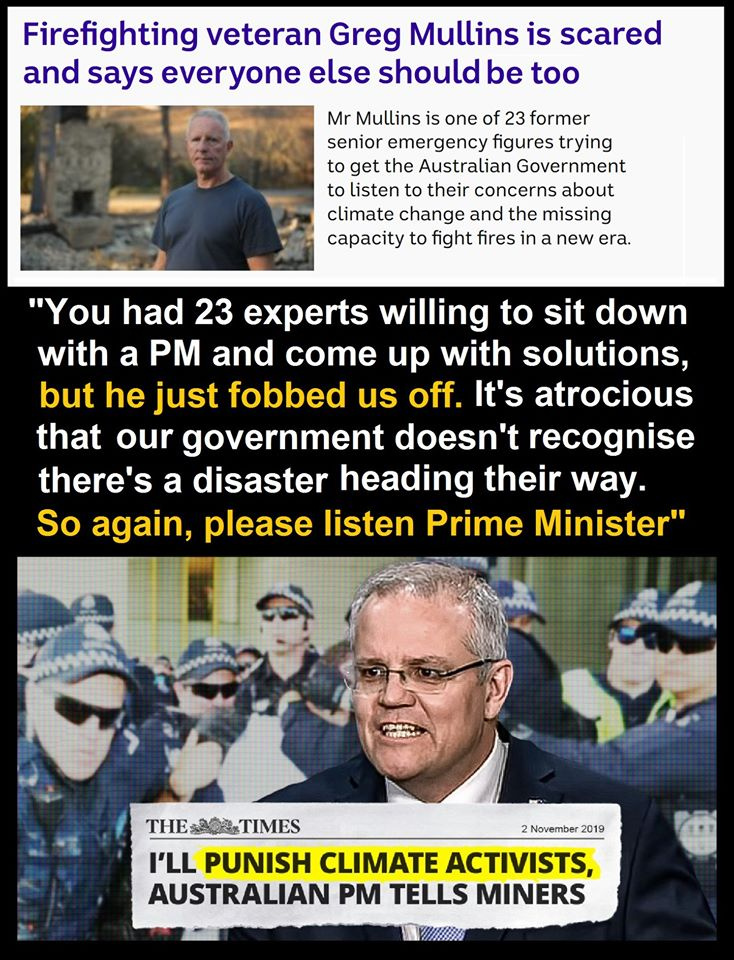
→ Now all we need is leadership that isn’t dismissive of the facts.
They are not terrified of the facts because a few months ago they were able to demonstrate climate change is neither a significant vote getter for the opposition nor a vote loser for themselves. They would be terrified if either was the case.
5 Likes
They showed that they could market their way to victory. What the facts will do to their donors - that’s terrifying.
4 Likes
23 out of 30 Queensland electorates would agree!
4 Likes
And another one in case anyone has not been paying attention.
Is this getting scary or what?

3 Likes
No, it will be karma. Too bad the spoils of victory cannot be reserved just for them 
4 Likes
