Let’s use ISO 9001 as an example. What is it really about in its core and how is it portrayed in advertising? Wouldn’t letting the laymen have a look be insightful? And no, I am not asking the question, I am posing it as an argument to support @meltam’s view that (my words) the less opaque the better in the general case.
3 Likes
Possibly not as one would not know how the quality standards impacts on advertising, as AS9001 is a framework AS for the development and implementation of a quality system. Without knowing the quality system of the individual business, the AS is not very useful to a consumer.
1 Like
Exactly. 9001 is often portrayed as ‘quality’ not a ‘system’ to make the point.
edit: I love the CE mark too. Especially the rigours at #6. The cost of learning how it works? $0.00 from the first google hit.
The UK again comes up at the top again for ISO9001 and it is noteworthy as compared to the CE mark, 9001 certification requires an external certifying audit to achieve 9001 status. Also $0.00 for an overview.
Letting go of 9001, it seems there are businesses and organisations that do illuminate many (not all) standards, but they need to be sought out.
2 Likes
When a government legislation, regulation, by-law, etc refers to an Australian Standard and that standard cannot be read for free (on paper or electronic medium) it means the process of using SAI to manage standards has crazily omitted an important function/purpose for its existence.
When an Act etc refers to a Standard instead of repeating the contents of the standard verbatim (which is understandable considering updates) the leel of government making that standard “mandatory” needs to organise with SAI or whoever for that standard to be free to the citizen, consumer, et al.
6 Likes
Do you have any examples, I am not aware of any? The only one possibly may be mandatory labelling of child seats with AS stickers. This is about labelling which can’t be done without AS certification.
Even if they were, they wouldn’t apply to individuals (e.g. mum and dads have to do something in accordance with an AS). It would apply to manufacturers or businesses who make products or provide service.
1 Like
The last one I referenced for personal use was pool fencing, wanting to put cover over pump and filter that were proximal to existing fence.
There seem two discussions going on. One based on policy of whether the public should have access to standards for no or nominal cost, and the other questions whether having that access would be useful and since an explicit example seems elusive it should not matter that they are ‘locked up’ to amounts of $100’s each in quantity of one.
I’ll opine that whether or nor useful, when I see a product meeting a standard, sometimes I am interested in knowing what it means in a practical sense. Having to pay $100’s?
‘What do they have to hide’ is a common response to such ‘lock-ups’ although secrecy of detail if not action seems increasingly common in everything government touches.
Licenses to use are what they are, and there are many examples of licenses giving individual consumers a free ‘ride’ while charging commercial, business, and consulting interests, so the concept is not difficult as I see it. The standards should be on an accessible library whereby the user has to declare their status, and if they misrepresented and were caught out, SAI Global could go after them for damages.
4 Likes
Queensland legislation, and likely all other states/territories, often call on Australian Standards. Legislated Codes of Practice in Qld also rely and call on standards for compliance.
EG Qld Plumbing and Waste Water Code.
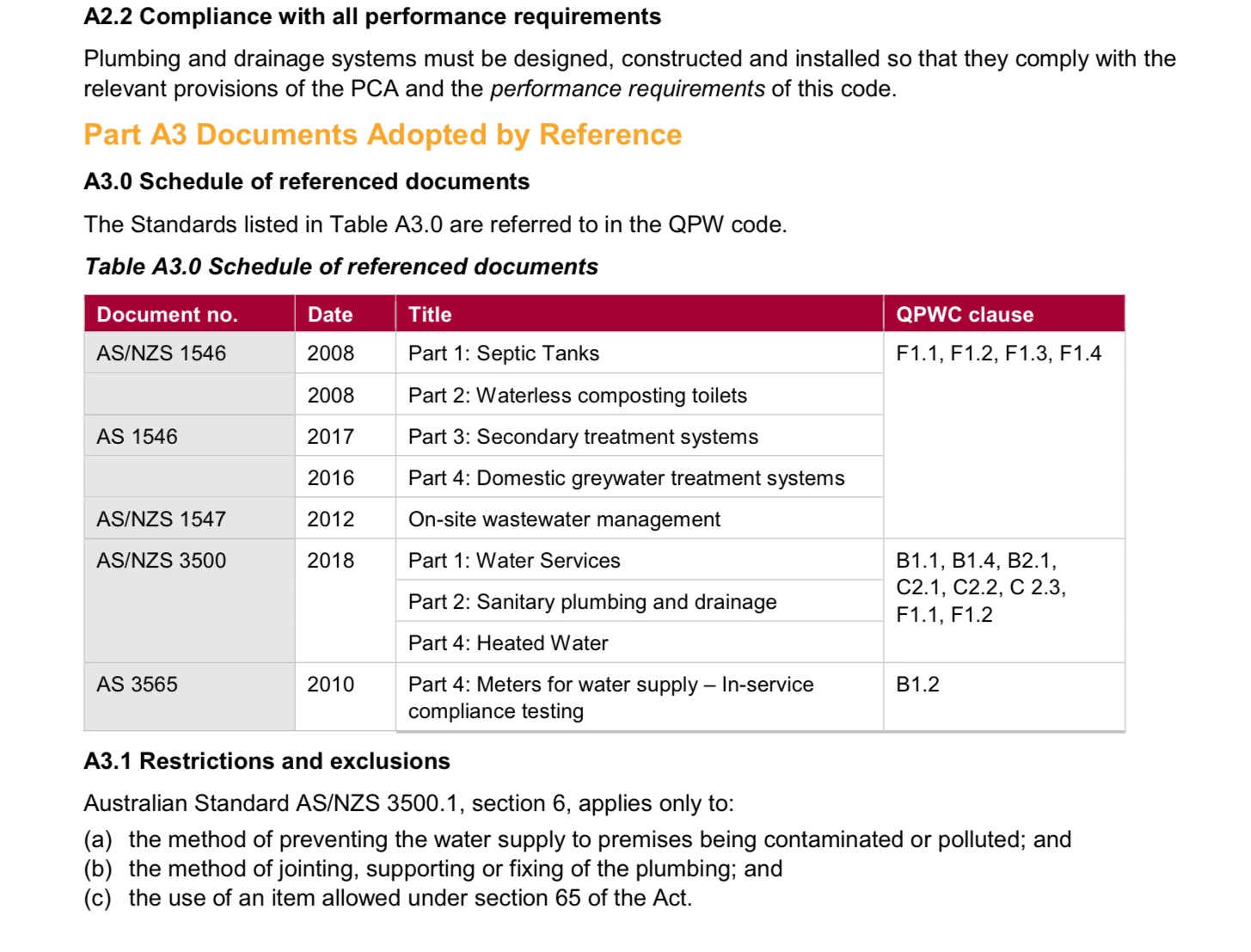
In practice, how the requirements for consumer/home owner needs are met are generally specific to a trade or occupation, seller/manufacturer, installer etc.
For the average consumer or home owner, there are State and LGA resources. These generally cover the essentials. EG You need a licensed plumber or electrician to do ‘xyz’, Can I build a deck, Pool Safety basics. It is worthwhile looking for these resources first, as they are purpose written.
2 Likes
We had our annual pest inspection & treatment carried out last week.
The report refers to at least two Australian Standards but of course I would not be able to read them even if I wanted to so I have to presume that everythin was done correctly.
2 Likes
Pool fencing is an interesting one that I am also familiar with (in Qld). There is an Australin Standard for it, and the states legislate that one has to comply with pool safety laws. These laws state that one has to comply with pool safety standards nominated in regulation. In Queensland, these are three documents which are used to compioe the Qld pool safety guidelines. These guidelines include relevant measures from the AS. In Queensland one has to comply with the pool safety guidelines.
In Queensland, this document is the reqyirements pool owners need to comply with. From what I understand, other states have similiar arrangements.
While AS is used to develop the guidelines, a copy of AS is not needed to ensure compliance by an individual.
2 Likes
Interesting link you provided…it goes on to say:
"3.6 What is the pool safety standard
The pool safety standard is the minimum requirements that a swimming pool barrier must meet to comply with Queensland’s pool safety laws. In Queensland the pool safety standard is the QDC MP 3.4 and the Australian Standard (AS) 1926–2007 Parts 1 and 2 as modified by the QDC. Please note that later versions of the Australian Standard do not apply in Queensland unless they are adopted by a new version of the QDC.
A pool owner’s pool fence must comply with the pool safety standard. The current pool safety standard replaces all the pool safety standards that previously applied to swimming pools. Refer to Appendix F for previous standards applicable in Queensland.
Appendix A of these guidelines provides some basic information about the pool safety standard. For further details, please refer to the pool safety standard, which is available on the department’s website www.hpw.qld.gov.au/PoolSafety."
So they make reference to the AS (older version unless a new version is adopted by QDC). They state they modify the Standard (so is it really the AS if it is modified? How would you know?). They even supply a link to the ASs on the Qld Govt website which resolves to an error page. Further documents on Pool Safety also make reference to the ASs but do not include those Standards in the documentation (they do include parts at times).
There are lots of examples of referencing AS in Govt legislation beyond even the one you supplied on Pool Fencing/Safety, including the one pointed out by @mark_m. There is even a Standards Australia document on how to incorporate Standards into legislation:
A 2016 report by the WA Govt found that if a Standard was incorporated into legislation it should be available to the public. This is of particular importance they noted because failure by the public to then follow these Standards would expose the public user to sanctions, criminal law, fines and similar “A failure to comply with their terms may carry serious consequences, as will be outlined in this report –consequences such as a lack of public safety, criminal sanctions and dismissal from employment”.:
From the Executive Summary (I think well worth reading in regards to the findings expressed in it as it pertains to this topic)
" 3. With increasing frequency, however, standards are becoming law through being incorporated in delegated legislation. This Committee believes that it is much more important that the public is aware of what such a standard (law) says, not only because everyone is entitled to know the law as it applies to them but also so that compliance may be better achieved. Generally, laws made by parliaments and the executive through statutes and statutory instruments, or local laws made by local governments, are freely available to everyone though libraries and websites, but this is not the case with material such as the standards which are adopted in those instruments or local laws.
4. This Committee is tasked with the scrutiny of delegated legislation on behalf of the Parliament of Western Australia, but where such incorporation by reference of a standard has taken place, such scrutiny comes at a price. Of more importance though is the fact that restricting free access for members of the public to the laws that apply to them is contrary to the rule of law principles that apply to all democracies such as ours."
& in their Findings
"Finding 1: The cost of creating the content and the intellectual property in Australian Standards is borne by Standards Australia, but this is entirely dependent on the voluntary efforts of others. The Committee finds that the current system for the production and subsequent publication of Standards created by the contractual arrangements entered into between Standards Australia and SAI Global Ltd. in 2003 provides a financial advantage to the latter.
2.31 In the view of this Committee, it is important that no similar arrangements are made upon the expiry of the relationship.
2.32 In a welcome nod to transparency, the National Construction Code ( NCC) has recently become freely available online on the website of the ABCB, as mentioned above. This is not a product of Standards Australia. It was produced by the ABCB with monies provided by Commonwealth and State and Territory Governments. Having said that, this version of the Code still incorporates over 200 Standards (according to the website of SAI Global), none of which are similarly freely available. An online subscription to the Code and the Standards referenced in it is $2,510 per year as of May 2016.
2.33 Until very recently, those 200 Standards, along with all of the other Standards that are published by Standards Australia and that may be accessed via the SIA Global database, could be viewed at the State Library of Western Australia in Perth. However, on 10 May 2016, the Committee was made aware that contractual negotiations between the Library (indeed, all the State Libraries and the National Library of Australia) and SAI Global had broken down. This is clearly an unhelpful development."
The Findings of the Committee would seem to disagree with your statement that “While AS is used to develop the guidelines, a copy of AS is not needed to ensure compliance by an individual.”
3 Likes
For the pool standard, this is definitely the case, as you noted, the AS for pool safety is referenced on the guideline, but its content has been modified. If one uses the AS instead of the Queensland Pool Standard, one would be using a document which is not the final version used for the Qld pool standard (as the AS content has been modified) and may be superceded by other requirements.
I possibly used poor wording, what I was trying to say is where legislation compels an individual (not a business) to do something in accordance with an Australian Standard. I am unaware of any examples in Queensland for Commonwealth, State or Local Laws.
1 Like
Is there a distinction? I’ve read much legislation which defines a business and a corporation as a “person”. That would seem to indicate that, wherever the term “person” is used, it applies to individuals and other entities. In fact, I don’t remember ever reading legislation that specifically limited requirements to businesses.
It does seem that Australian Standards are so integral to life that they should be freely accessible common property. Time to nationalise?
1 Like
One example that compels an individual to comply with an AS
“When you ride a bicycle or an electric powered wheeled recreational device or a personal mobility device like a rideable, you must wear an Australian Standard (AS) approved bicycle helmet. You must securely fit and fasten it. An approved bicycle helmet means a helmet that complies with AS 2063 or AS/NZS 2063”
The legislation that requires this compliance is found at https://www.legislation.qld.gov.au/view/html/inforce/current/sl-2009-0194
"5 Compliance with standards
    (1) In this regulation, unless otherwise stated—

        (a) a reference to a standard using the designation made up of ‘AS’ and a number is a reference to the standard as in force from time to time under that designation; and

        Example—

            ‘AS 1754’ is a reference to the standard that is in force under that designation at the relevant time, including, for example, AS 1754–1991.

        (b) a reference to a standard using the designation made up of ‘AS/NZS’ and a number is a reference to the standard as in force from time to time under that designation; and

        Example—

            ‘AS/NZS 1754’ is a reference to the standard that is in force under that designation at the relevant time, including, for example, AS/NZS 1754–1995, AS/NZS 1754–2000 or AS/NZS 1754–2004.

        (c) a reference to a standard using the designation made up of ‘UN ECE’ and a number is a reference to the standard as in force from time to time under that designation.

        Example—

            ‘UN ECE 22.05’ is a reference to the standard that is in force under that designation at the relevant time.

    (2) If this regulation requires a person to fit or use a thing that complies with a standard mentioned in subsection (1), the person complies with the requirement if, when the thing was manufactured, the thing complied with the standard in force under the designation at that time.

    (3) In this section—

        standard means AS, AS/NZS or UN ECE."
&
"256 Bicycle helmets
    (1) The rider of a bicycle must wear an approved bicycle helmet securely fitted and fastened on the rider’s head.

    Maximum penalty—20 penalty units."
Another part of the Act spells it out for Motorcycle Helmets
"(3) In this section—
approved motorbike helmet means a helmet that—

(a)complies with—

    (i) AS 1698; or

    (ii) AS/NZS 1698; or

    (iii) UN ECE 22.05; or

    (iv) another standard the chief executive considers is at least equal to a standard mentioned in paragraph (i) to (iii); and

(b) bears a label, or similar mark, indicating compliance with a standard mentioned in paragraph (a)."
The Subordinate Legislation that defines the approved Bicycle helmet types is found in:
Transport Operations (Road Use Management—Road Rules) No. 246, 1999 ¡
SCHEDULE 6 †
DICTIONARY
section 4 “approved bicycle helmet” means a helmet that complies with—
(a) AS 2063.1 and 2063.2; or
(b) another standard the chief executive considers is at least equal to that standard.
“approved child restraint” means a child restraint that complies with—
(a) AS 1754–1989, parts 1, 2 and 4; or
(b) AS 1754–1991; or © another standard the chief executive considers is at least equal to that standard.
“approved motor bike helmet” means a helmet that complies with—
(a) AS 1698–1988; or
(b) another standard the chief executive considers is at least equal to that standard."
Plenty that uses Standards to compel individuals to use something.
No, the rider must wear a AS certified helmet and ensure it is securely fastened. It is the manufacturer of the hemet which must comply with AS2063 if the helmet is sold as a cycling helmet …the manufactuer must certify compliance with this standard…and show appropiate labelling for the consumer so that can purchase a AS2063 compliant helmet.
The helmet wearer does not need to have access to the standard, as they don’t need to comply with the standard. They only heed to oruchase and wear one that does and this is achieved through certification and labelling processes.
Yes there is, there is definition under an Act as you have rightly pointed out, and there is also what is called application of the Act…who the Act impacts on.
Using the example provided by @grahroll where hemets for cycling must comply with AS2063. The Act would state that a helmet produced for cycling head protection must meet the requirements of AS2063. An individual or user if the helmet will not be manufacturing helmets so the provisions relating to manufacturing have no application for an individual. If the individual owned a business which manufacturered helmets, then the provisions would apply and the business would need to demonstrate compliance and also meet ither measures. While legislation may define who a person is, the application of the Act will often dictate who the Act applies to.
2 Likes
The rider wearing a helmet is compelled to wear an approved helmet and that helmet must meet a Standard. Therefore they are compelled to do something in accordance with an Australian Standard ie they must wear an AS 2063 or other approved helmet that meets the Standard as determined by the Executive or they face a fine. They could make a helmet that complies with the Standard if they had the necessary skill and could get it certified as meeting that Standard, they still though are required to prove the helmet they are wearing meets the Standard…The manufacturers obviously attach labels to show a device is certified but the user is the responsible party to ensure it does comply when they purchase and then use the helmet. A user who trusts that the item is certified/approved for use and subsequently finds that it isn’t could still be fined and they could also seek restitution from the sellers. They might also seek leniency in Court but they would I think have to prove their case for such ie they used it in good faith relying on attached labels or similar.
If a person makes a helmet and wants to see if it meets the standard or purchases some at a shop and wants to compare them to the Standard referenced in the Legislation they currently must pay to see what that Standard requires…If they are required to use it by Law it should be easily and freely available to that person the requirements of that Standard that their Safety Gear must meet to be approved. It isn’t spelt out in the legislation beyond the reference to the AS.
More specifically in regards to what a person is capable of and must meet AS criteria can be found in WHS legislation:
" appropriate training in underwater medicine means training that results in knowledge of the matters specified in clause M3 of Appendix M to AS/NZS 2299.1:2007 (Occupational diving operations—Standard operational practice).
fitness criteria , in relation to diving work, means the fitness criteria specified in clause M4 of Appendix M to AS/NZS 2299.1:2007 (Occupational diving operations—Standard operational practice).
(1) A person must not carry out high risk diving work unless the person has the qualifications, knowledge, skills and experience required by AS/NZS 2299.1:2007 (Occupational diving operations—Standard operational practice) for work of the kind to be carried out by the person.
1 Like
This could occur, but the cost would be prohibitive (could be $10Ks to get testing, certification and labelling) when one can purchase a AS2063 labelled helmet. While it is possible, it is totally impracticable and we are talking about hypotheticals rather than almost all users.
If one did decide to make their own helmet (say for a world speed record where a particular specialist helmet was unavailable for purchase), then the cost of purchasing the AS would be insignificant to the costs to gain certification and AS labelling.
The user of the helmet has to ensure that it is labelled with the AS2063 sticker for the label. For motorbike helmets, these are often displayed on the exterior at the lower back of the helmet.
If one bought a helmet without a sticker, it can’t be worn as it does not show compliance with the standard.
If the helmet has a AS label and if later found to fail AS testing, then this would be the subject of a product recall. If the user was notified, say in writing from the manufacturer, that the helmet should not be worn and to should be returned…and the rider continued to wear the helmet, they would be a fool. I am not sure it they would be fined in such case.
I user could be fined if the helmet does not have an AS label, if the user placed a AS label on a non-compliance helmet (such as one made by oneself), or if the helmet was in a condition which did not provide necessary head protection (such as the helmet being cracked).
This is for interest sake only and not required by law. It is like looking at any As which is of interest.
Just asked my other half who up until recently, managed a national registered training organisation (RTO). This would be training under a business not an individual…an individual can’t self train for professional/occupational purposed as this is a direct conflict of interest and potentially unlawful.
The training would be through an RTO where the RTO would need to ensure individual has knowledge of the standard. The RTO could be audited and must demonstrate what information was contained in the training to ensure the person has the necessary ‘qualifications, knowledge’ for occupational diving operations.
If one could do their own training, then we could do our own training to become doctors, engineers, safety officers, alternative health practioners etc…well, maybe not the last one as they often do this themselves…
1 Like
Having browsed through this thread, my view is that there are two parallel, distinct camps.
-
Companies that engage in large scale design, construction, manufacture and operations. For them AS are the norm, as well as American & European Standards. Speaking from my experience as an Engineer, these Companies are well of there responsibilities under the law. The cost of subscribing to SAI Global would be negligible for them. The cost of compliance, particularly for Operating companies would dwarf their SAI subscription fees.
-
Camp 2, is where it has been highlighted when smaller firms and individuals are impacted by the AS. Examples have been given of pool fence builders and bicycle helmets. Here I have a dilemma. If I get a pool fence built, according to the installer, to AS standards how do I know this is really the case if there is no certification and audit process for the manufacturer/ installer? How am I supposed to know that it is my responsibility to ensure the if I buy a bicycle helmet, say on Gumtree or EBay that it should come with AS certification (l’m assuming bike shops would be on top of that.)
I don’t have any answers or suggestions but there does seem to be issue of how to make consumers aware of their responsibilities under legislation which calls up compliance to AS.
4 Likes
Wow team. Good one @Albie
I need to come up for some fresh air.
@PhilT suggested,
No stones seem to have been left unturned. At least on pools and helmets.
My lifelong day to day use professionally of numerous AS, ISO, DIN, ANSI, … and finally BS, leaves me lost.
We might offer to illuminate some of the more complex considerations on standards that cross national borders and proper Engineering.
I suspect @Albie and I could spend days chasing our tails. But that is not the point.
Is it just possible that we are making something more complex than it really needs to be? At least as far as consumer needs are concerned.
1 Like
Pool Safety Certificate from a registered safety inspector.
That’s apparently a legal requirement, and unfortunately ignorance is no excuse.
Yes, there are gaps, and risks of shonky tradies etc not doing the job right, or faked product labels.
3 Likes
